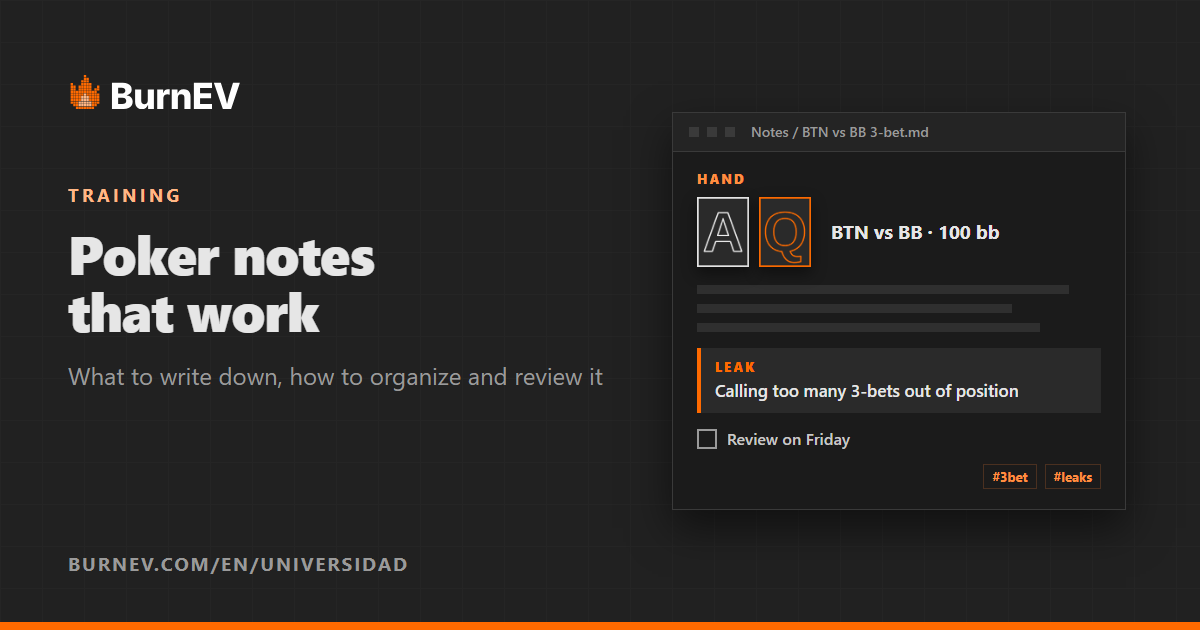
Almost every player who improves has one thing in common: they take poker notes. Not out of obligation, but because what you don’t write down, you forget. You review a tricky hand, understand why you misplayed it… and two weeks later you make the same mistake. In this guide you’ll learn what to write down, how to organize your poker notes so they actually help, and how to turn them into training, with a template you can copy today.
Why take poker notes
Studying poker without writing anything down is like going to the gym without knowing what you lifted last week: you’re busy, but you don’t progress. Notes do three jobs:
- They lock in what you learn: writing your reasoning in your own words forces you to understand it, and that sticks far better than rewatching a video.
- They reveal patterns: one mistake means little; the same mistake written down five times is a clear leak that deserves a study session.
- They get more out of your coach: show up to a lesson with your questions written down and your hands ready, and the hour is worth twice as much.
Notes are also the part of studying most players skip. To see how they fit with theory and practice, read how to study poker with a weekly routine.
What to put in your poker notes (and what not to)
The most common mistake is trying to write everything down. Useful notes are short and to the point. This is what’s worth keeping:
| Type of note | What to write | When |
|---|---|---|
| Reviewed hands | The spot, your decision, your reasoning and the conclusion | After each session, 2–5 hands |
| Leaks | The recurring mistake and the rule that fixes it | When a mistake shows up a second time |
| Questions for your coach | The specific question and the hand behind it | As soon as the question comes up |
| Concepts | The idea in your own words and an example of your own | After an article, video or lesson |
| Ranges | Which chart you use in each spot and why you adjusted it | Every time you change a range |
What’s not worth it: copying whole paragraphs from a course, logging hands you didn’t hesitate on, or noting results (“lost three buy-ins with AK”). The result of a hand doesn’t tell you whether you played it well; that’s what the EV of each decision is for.
Tip
Write your reasoning before you check the solution or ask. If you only write down the right answer, you lose the most valuable part: knowing where your thinking went wrong.
How to organize your notes
Messy notes never get opened again. You don’t need a complicated system; four sections are enough:
- Hands: one note per reviewed hand, with a title that names the spot (“BTN vs BB, 3-bet pot, 40bb”).
- Leaks: a single living note with your recurring mistakes and the rule that fixes each one. It’s the note you’ll reread most.
- Concepts: one note per topic (ICM, big blind defense, 3-bets…), linked to the hands that illustrate it.
- Coach: your list of questions for the next lesson and what they answered last time.
The key is linking: a big blind defense hand should lead to your concept note on how to defend the big blind, and that note to the range chart you use in that spot. When you review, you have all the context one click away.
A template for logging a hand
Always using the same structure makes writing quick and reviewing easy. This is the one we recommend:
- Spot: format, your position and your opponent’s, effective stack.
- Cards and action: your hand, the board and the betting sequence.
- My decision and why: what you did and what you were thinking at the time.
- Question: what you’re unsure about.
- Conclusion: the answer, with its source (solver, coach, chart).
- Action: what you’ll change or train (for example, “review the BB vs BTN defense chart”).
A well-logged preflop hand usually ends in a range chart. For example, if you hesitated with K9o on the button, the note should link to your opening range from that seat:
Sample range · BTN open · 6-max 100bb
Raise: 22+, A2s+, K2s+, Q4s+, J6s+, T6s+, 96s+, 85s+, 75s+, 64s+, 54s, A2o+, K8o+, Q9o+, J9o+, T9o.
If you don’t have your charts yet, start by building your own preflop ranges and review how to read a range chart.
How to take poker notes with BurnEV Note
A notepad or a loose document is fine to start with, but it falls short as soon as you want to see your ranges next to your hands. That’s why we built BurnEV Note, a free desktop app designed for poker notes:
- Your ranges inside your notes: insert any chart from your Burn EV range sets and it updates on its own when you change the range on the website. You can highlight only the labels you’re studying (for example, the 3-bets) and dim the rest.
- Cards as you type: type
!AhKdand the cards appear as images, perfect for logging hands in seconds. - Note templates: save the hand template from this article and every new note will start with its structure.
- Links between notes and tags: connect hands, concepts and leaks just like in the four-section system.
- Diagrams: a whiteboard to draw your decision lines with shapes, arrows and text, and export them to PNG.
- Your notes are yours: Markdown files on your computer that save automatically and work offline.
BurnEV Note is free for Windows 10 and 11. Use it without an account for your notes and diagrams, or connect it to Burn EV to bring your ranges into every note.
To see everything it can do, read the BurnEV Note announcement.
From notes to training
A note that doesn’t change your game is just a diary. The last step is turning each conclusion into something you practice:
- If it’s a range mistake: fix the chart in your range editor and drill it with questions until you stop missing it. We explain the method in how to memorize poker ranges.
- If it’s a concept: go back to your concept note and add the hand as an example.
- If it keeps happening: move it to your leaks note with a clear rule (“against UTG opens, KJo is a fold”).
Common mistake
Writing a lot and never rereading it. Notes you don’t review are worthless: three hands written up well and reread at the weekend beat twenty that nobody opens again.
Drill the charts that come out of your notes in Burn EV: hand quiz, blind mode and spaced repetition. Try it free for 14 days.
A weekly review routine
| When | What to do with your notes |
|---|---|
| During the session | Tag the hands you hesitated on, without stopping to analyze them. |
| Right after (10 min) | Log 2–5 hands with the template and write your reasoning. |
| The next day | Look up the answers and fill in the conclusion and the action. |
| At the weekend (20 min) | Reread the week, update your leaks note and prepare questions for your coach. |
With this routine, your notes stop being a junk drawer and become your study plan. And if you want to tackle the most expensive mistakes first, start with the most common preflop mistakes.
Frequently asked questions
What should I write down after a poker session?
Two to five hands you hesitated on, with the spot, your decision, your reasoning, your question and the conclusion. Plus any mistake that keeps coming back and your questions for your coach.
Is it better to take poker notes on paper or on a computer?
Paper helps memory, but a computer lets you search, link notes and see your ranges next to your hands. For poker notes you’ll review often, a notes app like BurnEV Note is more practical.
How should I organize my poker notes?
In four sections: reviewed hands, leaks, concepts and questions for your coach. Link each hand to its concept and to the range chart for that spot so you review with all the context.
Is BurnEV Note free?
Yes. BurnEV Note is free for Windows 10 and 11. You can use it without an account; you only need a Burn EV account to insert your range charts into your notes.
Read next: how to study poker: a weekly routine to improve.