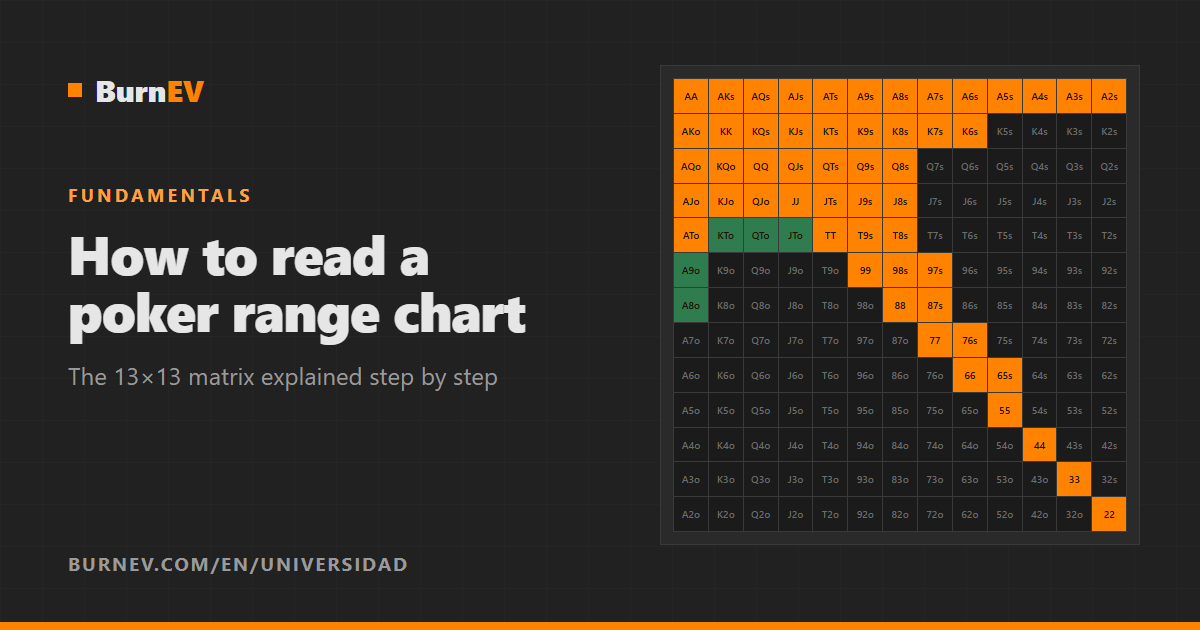
A poker range chart sums up in a single image what to do with each of the 169 starting hands in a specific spot. If you know how to read it, you can study any preflop range in seconds; if you don’t, it’s just a mosaic of colors. In this guide you’ll learn to read the 13×13 hand matrix step by step, with real examples.
What is a poker range chart?
A range is the set of hands you take an action with in a given situation: for example, the hands you open from the button with 40 big blinds. Writing it as a list (“22+, A2s+, K9s+…”) is precise but hard to picture, so it’s shown as a grid of 13 rows by 13 columns, one for each card rank from Ace down to 2.
Each square is a hand type and its color shows the action. That way you can see the shape of the range at a glance: where its edges are, which hands are clear plays and which ones are borderline. That’s why every study tool, from solvers to range trainers like Burn EV, uses this format.
How the 13×13 hand matrix is laid out
Rows and columns follow the same order: A, K, Q, J, T, 9, 8, 7, 6, 5, 4, 3, 2 (T stands for 10). To find a hand, look for the row of its higher card and the column of its lower card, or the other way round depending on the zone, as you’ll see below.
- The matrix has 169 squares: 13 pocket pairs, 78 suited hands and 78 offsuit hands.
- The strongest hands (AA, AKs, AKo) are in the top-left corner and the weakest (32o, 22) in the bottom-right.
- The further you move from the top-left corner, the weaker the hand usually is.
The three zones: pairs, suited and offsuit
The key to reading any chart is the diagonal, which splits the matrix into three zones.
The diagonal: pocket pairs
From AA in the top-left to 22 in the bottom-right you’ll find the 13 pocket pairs. Each pair has 6 possible combinations (for example, A♠A♥, A♠A♦, A♠A♣, A♥A♦, A♥A♣ and A♦A♣).
Above the diagonal: suited hands
The top-right triangle holds hands of the same suit, marked with an s: AKs, KQs, 76s… The row shows the high card and the column the low card. Each suited hand has 4 combinations, one per suit.
Below the diagonal: offsuit hands
The bottom-left triangle holds hands of different suits, marked with an o: AKo, KQo, 76o… Here the column shows the high card and the row the low card. Each offsuit hand has 12 combinations, so it weighs three times as much as its suited version.
Tip so you don’t get lost
AKs and AKo sit in mirror-image squares across the diagonal. Find one and the other is its reflection. Suited hands are always on top because they play better and make it into more ranges.
Colors and legends: which action to take
Each color stands for an action, and the chart’s legend tells you which one. There’s no universal standard, but this is the usual convention:
| Typical color | Action | Meaning |
|---|---|---|
| Orange or red | Raise / open | Raise or open the pot |
| Green | Call | Match the bet |
| Dark red | All-in / 3-bet | Re-raise or shove |
| Blue | Limp | Complete the blind without raising |
| No color | Fold | Throw the hand away |
Always read the legend before the chart: the same color can mean different things in two tools, and in your own material you can define whatever actions you need (in Burn EV, for instance, each legend group has its own labels and colors).
Example · CO open vs limpers · 30bb
Raise: 22+, A2s+, K5s+, Q8s+, J8s+, T8s+, 97s+, 86s+, 76s, 65s, ATo+, KJo+, QJo. Call: A9o-A7o, KTo, QTo, JTo.
Mixed hands and frequencies
Some squares are split into two or more colors. These are mixed hands: the strategy plays them one way some of the time and another way the rest, for example 70% call and 30% 3-bet. The stripes are usually proportional to each frequency.
These hands show up at the edges of the range, where two actions have almost identical expected value. In practice you have two reasonable options:
- Simplify: always pick the majority action. You lose very little EV and the range is easier to remember.
- Randomize: use something external (the seconds on a clock, the suit of your cards) to decide and stick to the frequencies.
If you’re just starting out, simplify. What matters is getting the clear hands right, and they’re the vast majority.
What percentage of hands does a range play?
Many charts show a percentage: “open 42% from the button”. That number doesn’t count squares, it counts combinations. There are 1,326 starting-hand combinations in total:
| Type | Squares | Combos per square | Total combos |
|---|---|---|---|
| Pairs | 13 | 6 | 78 |
| Suited | 78 | 4 | 312 |
| Offsuit | 78 | 12 | 936 |
| Total | 169 | — | 1,326 |
That’s why adding offsuit hands widens a range much faster than adding suited ones: adding KTo (12 combos) is the same as adding three suited hands like KTs, QTs and JTs.
Paint your own charts and instantly see what percentage each range plays. Burn EV is free for 14 days.
Two examples to practice
Example 1: UTG open (6-max, 100bb)
From first position there are five players left to act, so the range is tight: all pairs, suited aces, strong broadways and a few suited connectors. Notice how the range forms a compact block hugging the top-left corner.
Sample range · UTG open · 100bb
Raise: 22+, A2s+, KTs+, QTs+, JTs, T9s, 98s, 87s, 76s, AJo+, KQo.
Example 2: button open (6-max, 100bb)
On the button only the blinds are left, so the range opens up a lot: almost every suited hand, plenty of offsuit hands with an ace or a king, and connectors. The block stretches to the right (suited) and downwards (offsuit).
Sample range · BTN open · 100bb
Raise: 22+, A2s+, K2s+, Q4s+, J6s+, T6s+, 96s+, 85s+, 75s+, 64s+, 54s, A2o+, K8o+, Q9o+, J9o+, T9o.
Compare the two charts: almost all the difference is at the edges. That’s where mistakes happen and where training pays off. In preflop opening ranges by position you’ll find every other seat explained.
Common mistakes when reading ranges
Common mistake
Mixing up the suited and offsuit zones. If you read K9 in the king row above the diagonal it’s K9s; below it, it’s K9o, and they often have different actions.
- Ignoring the context: a chart only applies to its own spot (position, previous action, effective stack and format). A 100bb button range doesn’t work at 15bb.
- Counting squares instead of combos: a range with lots of offsuit hands is wider than it looks.
- Memorizing without understanding the shape: learn in blocks (pairs, suited aces, broadways…) and focus on the edges. We explain how in how to memorize poker ranges.
Frequently asked questions
How many hands are in a poker range chart?
The matrix has 169 squares (13 pairs, 78 suited and 78 offsuit), which add up to 1,326 different card combinations.
What do the s and o mean in poker hands?
The s (suited) means both cards are the same suit and the o (offsuit) means they’re different suits. Suited hands sit above the diagonal and offsuit hands below it.
What is a mixed hand in a range chart?
It’s a hand the strategy plays with several actions at a given frequency, for example 60% raise and 40% call. It’s drawn split into colored stripes.
How do you calculate the percentage of a range?
Add up the combinations of every hand in the range and divide by 1,326. A pair contributes 6 combos, a suited hand 4 and an offsuit hand 12.
Now you know how to read a chart. The next step is to build your own preflop ranges and train them until they come naturally at the table.