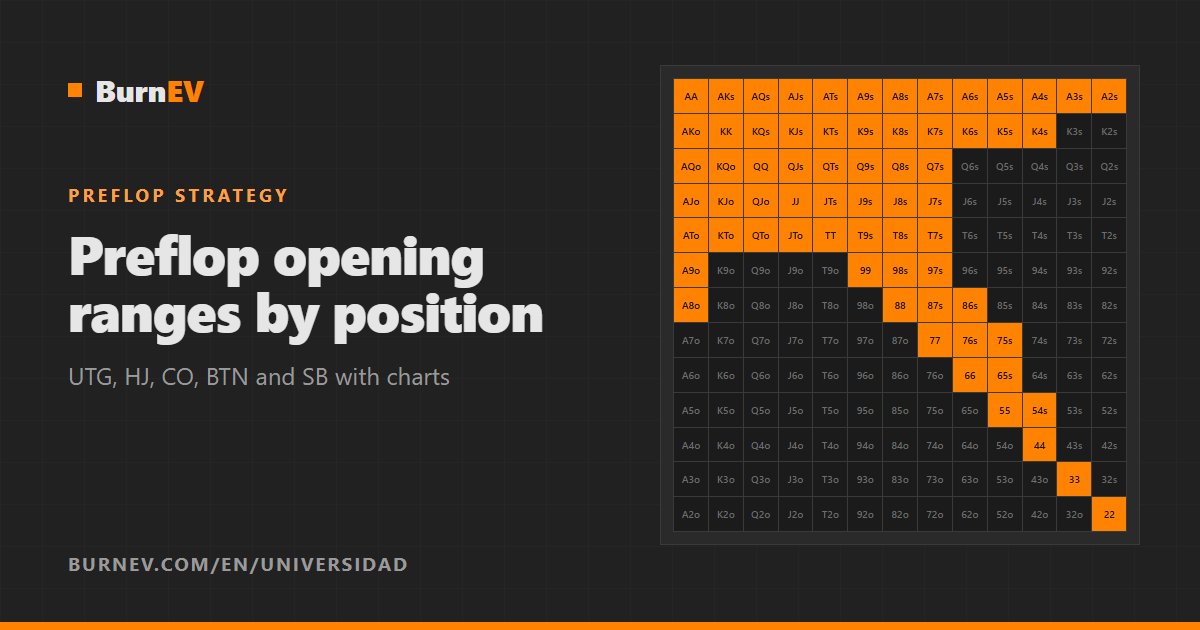
Your preflop opening range is the decision you repeat most in a session: every time the pot is folded to you, you have to decide whether to open or fold. Getting it right from every seat is the foundation of any winning strategy. In this guide you’ll see what to open from each position in 6-max, why ranges change so much and how to adapt them to tournaments.
Why your opening range depends on position
Two factors explain almost everything:
- Players left to act. The more players behind you, the more likely one of them has a strong hand and 3-bets you or calls with something better. From UTG there are five opponents left; from the button, only the two blinds.
- Position after the flop. If you open and get called, playing the rest of the hand in position (acting last) gives you information and control. The button always plays in position postflop; the blinds almost never do.
That’s why ranges widen as you get closer to the button. The positions in 6-max are: UTG (or LJ), HJ (hijack), CO (cutoff), BTN (button), SB (small blind) and BB (big blind). At 9-handed tables there are more early positions (UTG, UTG+1, UTG+2…) that open even tighter.
Summary: how much to open from each position
These percentages match the examples in this article for 6-max cash games at 100bb. They’re approximate: every solver, rake structure and format gives slightly different numbers, but the progression is always the same.
| Position | Players left to act | Opening range |
|---|---|---|
| UTG | 5 | ≈ 17–18% |
| HJ | 4 | ≈ 21–22% |
| CO | 3 | ≈ 28–30% |
| BTN | 2 | ≈ 42–48% |
| SB | 1 | ≈ 40–55% (depending on strategy) |
How to read the charts
Pairs are on the diagonal, suited hands above it and offsuit hands below. If you need a refresher, see how to read a poker range chart.
UTG: the tightest range
From first position you’re up against five opponents who could have anything, and you’ll almost always be out of position against whoever calls. The range is limited to hands that play well in big pots:
- All pocket pairs (the small ones for their set-mining potential).
- All suited aces, for their flush potential and blockers.
- Suited broadways and high suited connectors.
- Few offsuit hands: AJo+ and KQo.
Sample range · UTG open · 6-max 100bb · 17.6%
Raise: 22+, A2s+, K9s+, Q9s+, J9s+, T8s+, 98s, 87s, 76s, 65s, AJo+, KQo.
Common mistake
Opening KJo, QJo or ATo from UTG “because they’re high cards”. Against strong ranges they’re dominated by AJ, AQ or KQ and lose a lot of money in big pots.
Hijack: opening a little wider
With one fewer player left to act, you add the next step of each block: more suited kings, a low suited connector and the first offsuit broadways (ATo, KJo, QJo).
Sample range · HJ open · 6-max 100bb · 21.6%
Raise: 22+, A2s+, K7s+, Q9s+, J9s+, T8s+, 97s+, 87s, 76s, 65s, 54s, ATo+, KJo+, QJo.
Cutoff: blind stealing begins
From the cutoff only the button and the blinds are left. Often everyone folds and you take the pot uncontested, so opening medium-strength hands is already profitable. The range grows mainly through suited hands (K4s+, Q7s+, J7s+) and offsuit aces (A8o+).
Sample range · CO open · 6-max 100bb · 29.1%
Raise: 22+, A2s+, K4s+, Q7s+, J7s+, T7s+, 97s+, 86s+, 75s+, 65s, 54s, A8o+, KTo+, QTo+, JTo.
Button: the best seat at the table
On the button you’re in position against anyone who calls, and only two players (the blinds, who have already posted forced bets) can defend. That’s why you open a huge range: almost every suited hand and a good chunk of offsuit hands.
Sample range · BTN open · 6-max 100bb · 42.1%
Raise: 22+, A2s+, K2s+, Q4s+, J6s+, T6s+, 96s+, 85s+, 75s+, 64s+, 54s, A2o+, K8o+, Q9o+, J9o+, T9o.
Against blinds that rarely defend, the button can open even wider. Against aggressive blinds that 3-bet a lot, it’s worth trimming the weakest offsuit hands.
Small blind: raise or limp
The small blind is a special case: only the big blind is left, but you’ll be out of position for the whole hand. There are two common strategies:
- Raise-only: open around 40–45% with a slightly bigger size (2.5–3bb) and fold the rest. It’s the easiest to learn.
- Mixed with limps: complete with many medium hands and raise the best ones plus some bluffs. It plays more hands (up to 55% or more) but you also need to study how to continue after limping.
If you’re just starting out, use the raise-only strategy and add limping later.
Paint these ranges in your account and drill every position with the hand quiz until you never miss an edge.
Open-raise sizing: how much to raise
Sizing matters as much as the range, because it changes the price your opponents pay:
| Format | Typical size |
|---|---|
| Online 6-max cash | 2–2.5bb (a bit more from the SB) |
| Tournaments with antes | 2–2.3bb |
| Short-stacked tournaments (≤ 20bb) | 2bb or a min-raise, or just shove |
| Live games | 3bb or more, depending on the table |
Pick one size and use it with your whole range from each position. Varying it with hand strength gives information away.
Tournament adjustments
In tournaments, ranges change for three reasons:
- Antes: there’s more money in the pot before the deal, so stealing the blinds is more profitable and ranges widen.
- Effective stack: 40bb doesn’t play like 100bb, and below 20bb open-shoving and 3-bet shoving come into play. We explain it in push/fold strategy with a short stack.
- ICM: near the money, losing chips hurts more than winning them helps, so it pays to play a bit tighter.
That’s why it’s common to have one chart per stack depth for each position. In Burn EV each chart is titled with its effective stack (12, 2-6, 20+…) and the practice modes quiz you on every hand at that stack, just like at the table.
Frequently asked questions
What percentage of hands should I open from the button?
In 6-max cash games at 100bb, roughly 40% to 48%, depending on how much the blinds defend. In tournaments with antes it can be even more.
Why do you open more suited hands than offsuit hands?
Suited hands can make flushes and draws that give them more equity and playability after the flop. They also have only 4 combinations versus 12 for an offsuit hand, so adding them barely widens the range.
Are opening ranges the same for tournaments and cash games?
Not quite. In tournaments, antes, effective stacks and ICM change the ranges. Use specific charts for each format and stack depth.
Do I need to memorize every range at once?
No. Start with the button and cutoff, the seats you open from most, and add the rest once you’ve mastered them. We explain a method in how to memorize poker ranges.
Next step: learn to memorize these ranges so you can apply them without hesitating at the table.