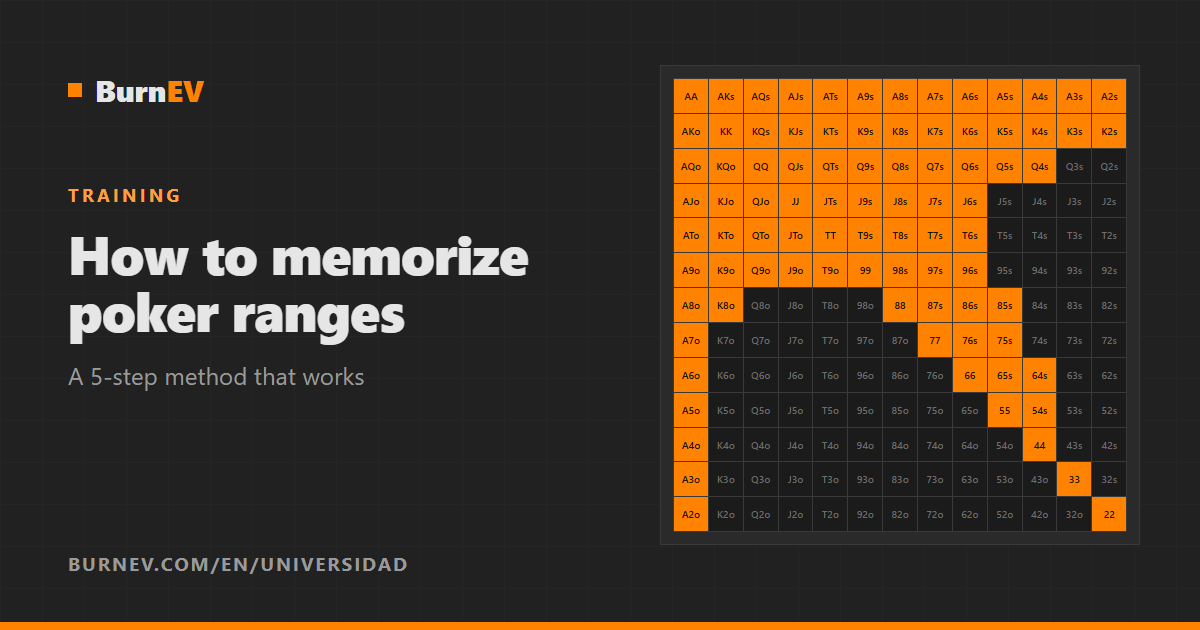
Almost every player has range charts. Very few actually know them. You can tell at the table: with 15 seconds on the clock and a borderline hand, either it’s automatic or you’re guessing. In this guide we explain how to memorize poker ranges with a method based on how memory really works, not on staring at charts over and over.
Why staring at charts won’t help you memorize ranges
Reading a chart gives you a false sense of mastery: you recognize it, so you think you know it. But recognizing isn’t recalling. At the table nobody shows you the chart; you have to retrieve the answer on your own, with a specific hand in a specific spot.
Learning research boils it down to two very solid ideas that we’ll use throughout the method:
- Retrieval practice: trying to recall something (even if you get it wrong) locks it in far better than re-reading it.
- Spaced repetition: reviewing right when you’re about to forget is more effective than reviewing everything at once.
Step 1: understand the shape of the range before memorizing it
Memorizing 169 squares one by one is impossible, and unnecessary anyway. First, look at the chart as a picture and answer three questions:
- Roughly what percentage does it play? (If you don’t know how to work it out, see how to read a poker range chart.)
- Where are its edges? The last suited hand in each row and the last offsuit hand in each column.
- What’s special about it? A gap, a mixed hand, an action that only shows up here.
With those three answers you already have a mental skeleton to hang the details on.
Step 2: learn in blocks and edges
Group the hands into families and memorize only where each family ends. For example, for a button open:
| Block | What to remember |
|---|---|
| Pairs | All of them (22+) |
| Suited aces | All of them (A2s+) |
| Suited kings and queens | Where each row stops (K2s+, Q4s+) |
| Suited connectors | How low the connectors go (54s) |
| Offsuit | The edge of each column (A2o+, K8o+, Q9o+…) |
So instead of 70 separate hands you remember about 10 edges. Even more useful: compare each chart with the previous one. Learning the cutoff open is much easier if you think “it’s the hijack range plus these edges”.
Sample range · BTN open · 100bb
Raise: 22+, A2s+, K2s+, Q4s+, J6s+, T6s+, 96s+, 85s+, 75s+, 64s+, 54s, A2o+, K8o+, Q9o+, J9o+, T9o.
Tip
You’ll almost never miss the hands in the middle of the range. Focus your energy on the edges: that’s where 80% of mistakes happen.
Step 3: drill with questions, not reading
This is the step most players skip and the one that makes the biggest difference. Instead of looking at the chart, have someone (or a tool) quiz you: “BTN, 40bb, K7o: what do you do?”. You answer, check whether you got it right and move on to the next one.
For it to work, the questions need to meet three conditions:
- Full context: position, previous action and effective stack, just like at the table.
- Random hands: if you always follow the same order, you memorize the sequence, not the range.
- Instant feedback: when you miss, you see the right answer on the spot.
That’s exactly what Burn EV’s hand quiz does: it asks you hands from your own charts, with their spot and stack, corrects you instantly and also tracks your speed, because at the table being right isn’t enough: you have to be right fast.
Train your ranges with real questions instead of staring at charts. Try it free for 14 days.
Step 4: rebuild full charts from memory
Once you get almost every single question right, level up: take a blank chart and paint the whole thing from memory. This forces you to recall the complete shape of the range, not just isolated hands, and exposes the gaps the quiz doesn’t catch.
In Burn EV this is called blind mode: the chart starts empty, you pick an action and click the hands you think belong to it. Each hand tells you right away if it’s correct, and at the end you can reveal the solution to compare.
Common mistake
Always rebuilding the same charts. Mix it up: opens one day, defenses the next, short stacks the day after. Mixing similar spots forces you to tell them apart, which is exactly what happens at the table.
Step 5: review with spaced repetition
Whatever you learn today you’ll forget within a few days if you don’t review it. The fix isn’t to review everything every day, but to review each hand when it’s due:
- A hand you miss comes back a few minutes later.
- A hand you get right takes longer and longer to come back: the next day, a few days later, a week later…
That way you spend your time on what you don’t know yet and keep what you already know with very little effort. Burn EV’s practice has a spaced repetition mode (the recommended one) and a weak spots mode that focuses on the hands and actions you miss most.
A 20-minute daily routine
You don’t need two-hour sessions. Consistency beats intensity. A simple routine:
| Time | What to do |
|---|---|
| 5 min | Hand quiz with spaced repetition on everything you’re already studying. |
| 10 min | New chart: understand its shape, learn its edges and drill it with questions. |
| 5 min | Rebuild a chart from last week from memory. |
Once a week, check your stats: which charts and which hands you miss most. That’s your homework for the following week. If you play tournaments, always include short-stack charts, since that’s where preflop decisions matter most (we cover it in push/fold strategy with a short stack).
Frequently asked questions
How long does it take to memorize a poker range?
You can learn an opening range in one or two sessions if you study it in blocks and edges. What takes weeks is retaining it and not confusing it with similar ones, and that’s what spaced repetition is for.
Is it better to memorize ranges or understand why they’re played that way?
Both. Understanding the logic (position, players left to act, stack depth) helps you remember and adapt; memorizing lets you decide quickly and without mistakes at the table.
Do you need to memorize the frequencies of mixed hands?
Not at first. Play the majority action and focus on getting the clear hands right. Once you’ve mastered the range, you can start randomizing the mixed ones.
How many charts should I study at once?
Just a few. It’s better to master 4 or 5 charts for the most common spots than to half-know 40. Add new charts once you’re above 90% on the ones you already have.
Don’t have your charts yet? Start by building your own preflop ranges and then come back here to train them.