Lots of players lose money before the flop without realizing it. Preflop mistakes are small in each hand, but they repeat hundreds of times per session, and by the end of the month they add up to more than any failed bluff. These are the nine most common ones, how to spot them and how to fix them.
1. Open-limping
Entering the pot by just calling the big blind (open-limping) looks cheap, but it has every downside and no upside: you give up winning the pot uncontested, invite others in and reach the flop with a weak range and no initiative.
Fix: if you’re first in, raise or fold. The only common exception is the small blind, where some strategies limp on purpose.
2. Opening too wide from early position
Opening KJo, QTo, A9o or offsuit connectors from UTG “because they look pretty”. With five players behind, these hands often run into ranges that dominate them.
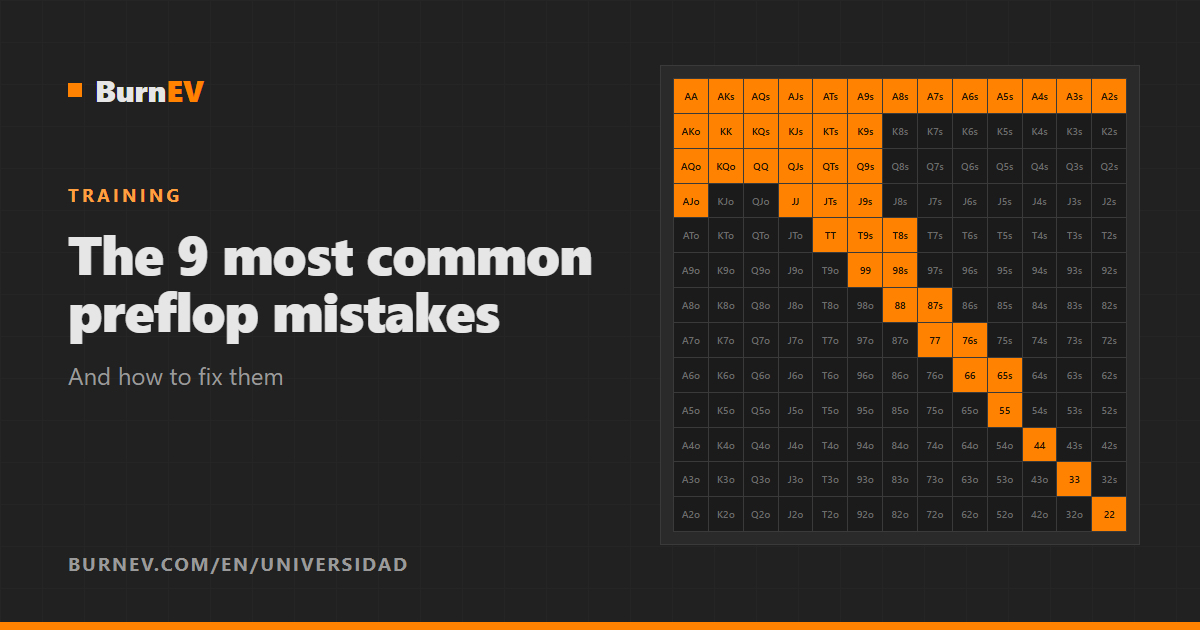
Sample range · UTG open · 6-max 100bb · 17.6%
Raise: 22+, A2s+, K9s+, Q9s+, J9s+, T8s+, 98s, 87s, 76s, 65s, AJo+, KQo.
Fix: from UTG, the only offsuit hands are AJo+ and KQo. Review the opening ranges by position.
3. Playing the same from every position
The opposite mistake: opening too little from the button and the cutoff. From the button only the blinds are left to act and you play in position; folding K8o, Q9o or 75s there is leaving money on the table.
Fix: your button range should be more than twice your UTG range. If it isn’t, you’re playing too tight in the best seats. We explain why in poker table positions.
4. Calling 3-bets out of position with dominated hands
You open KJo from the cutoff, the button 3-bets and you call. You’ll play a big pot out of position with a hand dominated by a good chunk of your opponent’s range (AK, AJ, KQ).
Fix: facing a 3-bet, medium offsuit hands are usually a fold. Call with pairs, playable suited hands and strong hands, and 4-bet the best ones plus a few bluffs with blockers.
5. Folding too much from the big blind
Folding everything that isn’t a “good hand” from the BB. Since you already have 1bb in and you close the action, the price to see a flop is very good, and folding too much gives away your blind over and over.
Fix: against 2.5bb button opens you defend around half your hands. See how in big blind defense.
Do you know how many of these mistakes you make? In Burn EV your stats show which hands and charts you miss most.
6. Only 3-betting premium hands
If you only re-raise with AA, KK, QQ and AK, your opponents notice quickly: they fold everything else and only pay you off when they’re ahead or have the odds to hit.
Fix: add 3-bet bluffs with good properties (A5s-A2s, some suited connectors) and adjust your range structure to the spot. It’s explained in when to 3-bet.
7. Ignoring the effective stack
Using the same range at 100bb as at 25bb, or calling an open with 15bb “to see a flop”. In tournaments, stack depth completely changes which hands are profitable and with which action.
Fix: have separate charts per stack depth and always look at the effective stack (the smaller of yours and your opponent’s). With a short stack, review push/fold and 3-bet shoving.
Tournament variant
Calling all-ins on the bubble as if chips were money. Near the payouts, ICM forces you to call much less.
8. Changing your sizing based on your hand
Opening to 2bb with medium hands and to 4bb with AA, or the other way round. Attentive players spot it right away and know what you have before the flop.
Fix: pick one size per position and situation and use it with your whole range. If you change the size, do it because of the table (opponents, stacks), not your cards.
9. Knowing your ranges without really knowing them
This is the most widespread mistake among players who study: they have the charts, they’ve looked at them many times, and still, with the clock running, they hesitate at the edges and end up guessing.
Fix: train your ranges with questions, not reading, and review them with spaced repetition. You’ll find the full method in how to memorize poker ranges.
How to spot your preflop mistakes
- Review your hands, always starting with the preflop decision: was the hand in your range for that spot?
- Check your stats if you use a tracking program: a very high VPIP from UTG or a very high fold-to-steal from the BB are clear warning signs.
- Test yourself: if you can’t get above 90% on a quiz of your own charts, you’ll miss more at the table.
And organize your study to fix them one by one with a weekly routine.
Frequently asked questions
What is the most common preflop mistake?
Playing too many hands from early position and open-limping. They’re the most frequent mistakes among beginner and intermediate players.
Why shouldn’t you limp in poker?
Because you give up winning the pot preflop, let more players in and reach the flop with a weak range and no initiative. If you’re first in, it’s better to raise or fold.
How do I know if I’m playing too many hands?
Compare your actual range with an opening chart for your position. If you open medium offsuit hands from UTG, or your percentage of hands played is similar from every seat, you’re playing too many from early position.
How do I fix my preflop mistakes?
Have charts for your common spots, drill them with questions until you’re above 90% accuracy and review your hands, always starting with the preflop decision.