In a cash game, 100 chips are worth $100. In a tournament they’re not: chips only turn into money depending on where you finish, and that changes everything near the payouts. ICM (Independent Chip Model) is the model that translates chips into real money, and understanding it is the difference between playing a tournament well and giving away your equity on the bubble.
What is ICM in poker?
The Independent Chip Model calculates how much money your stack is worth at a given point in a tournament, based on your chips, everyone else’s and the payout structure. To do so, it estimates the probability of each player finishing in each place (assuming the chance of winning is proportional to their chips) and multiplies it by that place’s prize.
The key idea: chip value isn’t linear. Doubling your stack doesn’t double your expected money, but losing it all does leave you with nothing.
An example with numbers
Three players are left at a final table with $100 in prizes: $50 for first, $30 for second and $20 for third.
| Player | Chips | % of chips | ICM value | % of the money |
|---|---|---|---|---|
| A | 5,000 | 50% | $38.39 | 38.4% |
| B | 3,000 | 30% | $32.75 | 32.8% |
| C | 2,000 | 20% | $28.86 | 28.9% |
Player A has half the chips but only 38% of the money. Player C, with 20% of the chips, has almost 29% of the money: the $20 for third place is already locked up. Each of the chip leader’s chips is worth less; each of the short stack’s is worth more.
The bubble: losing hurts more than winning helps
Now picture the bubble: 4 players are left with 2,500 chips each and only 3 get paid ($50 / $30 / $20). By symmetry, each stack is worth $25.
A player goes all-in and you have to decide whether to call in a 50/50 spot:
- If you win: you have 5,000 chips against 2,500 and 2,500. Your stack is now worth $38.33: you gain $13.33.
- If you lose: you’re out with no prize. You lose $25.
Doubling your chips only increases your money by 53%, but losing them takes away 100%. For the call to be profitable you need to win at least 25 ÷ (25 + 13.33) = 65% of the time, not the 50% that would be enough in a cash game.
The lesson
Near the money, a spot that’s neutral in chips (50/50) is clearly losing in money. That’s why good players call far less on the bubble.
The bubble factor
To sum up that asymmetry we use the bubble factor: how much money you lose when you lose an all-in divided by how much you gain when you win it. In the example: 25 ÷ 13.33 ≈ 1.9.
- A factor of 1 means chips and money are worth the same (as in cash).
- The higher the factor, the more equity you need to risk your stack.
- The factor is different for each player and against each opponent: it depends on both stacks and the others left at the table.
How ICM changes your ranges
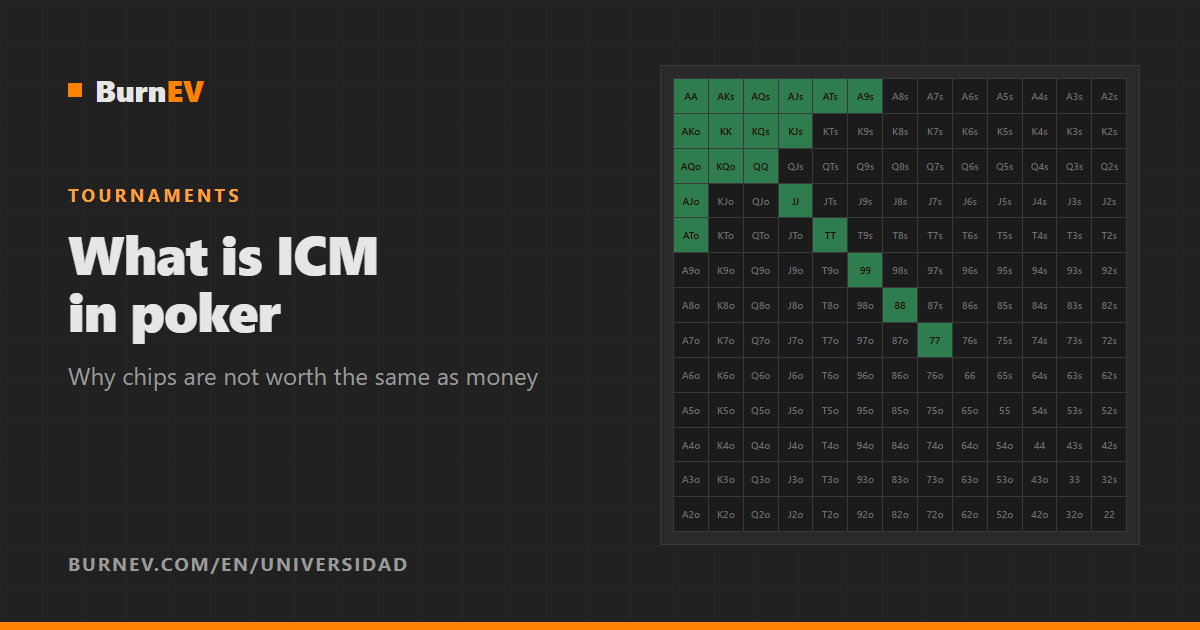
ICM affects calling ranges much more than shoving ranges, because when you shove you still have fold equity. Compare a range for calling a 10bb all-in, without and with ICM pressure:
Sample range · Call vs shove · 10bb · no ICM · 22.8%
Call: 22+, A2s+, K7s+, Q9s+, J9s+, A7o+, KTo+, QJo.
Sample range · Call vs shove · 10bb · bubble with ICM · 10.3%
Call: 77+, A9s+, KJs+, ATo+, KQo.
The calling range shrinks to less than half: the small pairs, weak aces and weakest broadways disappear. The exact figures depend on the stacks and the payouts, but the direction is always the same.
Create separate charts for each phase (normal, bubble, final table) and drill them in Burn EV. The effective stack goes in each chart’s title.
Who wins and who loses with ICM
| Stack | Effect of ICM | Adjustment |
|---|---|---|
| Big | Suffers little: losing an all-in doesn’t bust them | Pressure the others by opening and shoving more |
| Medium | Suffers a lot: can bust and has payouts to protect | Call much less, especially against the big stack |
| Short | Already counts on little; their stack is barely worth more | Shove while they still have fold equity, without waiting too long |
Common mistake
Calling the chip leader’s all-in with a medium stack on the bubble “because the hand is good”. If you lose, you’re out with nothing; if you win, you gain little. Lots of hands that would be a clear call in chips are a clear fold under ICM.
How to study ICM
Nobody calculates ICM at the table. You study it beforehand with dedicated ICM calculators that generate ranges for specific spots. The practical work is:
- Calculate the ranges for the most common spots (bubble, final table, different stack sizes).
- Simplify them and turn them into charts.
- Drill them until you recognize when a spot calls for tighter play.
If you don’t have your short-stack charts yet, start with push/fold with a short stack and continue with 3-bet shoving with 15–25 big blinds.
Frequently asked questions
What does ICM mean in poker?
Independent Chip Model: a model that calculates how much money each player’s stack is worth in a tournament based on everyone’s chips and the payout structure.
When do you need to consider ICM?
Mainly near the money bubble, at big pay jumps and at the final table. Early in a large tournament its effect is small.
Does ICM affect shoving and calling equally?
No. It affects calling much more, because when you shove you still win whenever your opponent folds. Calling ranges tighten far more than shoving ranges.
What is the bubble factor?
The ratio between what you lose when you lose an all-in and what you gain when you win it, measured in money. The higher it is, the more equity you need to risk your stack.
Read next: what EV is in poker.