A 3-bet is a preflop re-raise: someone opens and you raise again. It’s one of the most profitable weapons in modern poker and also one of the most misused. Some players only do it with AA and KK (and become predictable) while others do it with anything (and pay dearly for it). In this guide you’ll learn when to 3-bet, with which hands and with what sizing.
What is a 3-bet?
Preflop, the blinds count as the first bet. The open raise is the second and the re-raise is the third: hence the name 3-bet. If the original raiser raises again, it’s a 4-bet, and so on.
Why 3-bet?
Calling an open is simpler, but 3-betting has advantages that calling doesn’t:
- Value: with very strong hands, you build a big pot when you’re ahead.
- Fold equity: your opponent often folds and you take the pot without seeing a flop.
- Initiative: you reach the flop as the aggressor, and your continuation bets are more credible.
- Isolation: you push out the players left to act and play heads-up.
The question isn’t “is my hand good enough?” but “do I make more by re-raising than by calling or folding?”.
Linear 3-bet range
A linear (or “merged”) range 3-bets the best hands from the top down, with no gaps: high pairs, strong aces and the best broadways. Below that block, the rest of the playable hands are called or folded.
Sample range · BTN vs CO · linear 3-bet · 5.7% (+ 12.2% call)
3-bet: 99+, AJs+, KQs, AQo+. Call: 88-22, ATs-A2s, KJs-K9s, QJs, QTs, JTs, AJo-A9o, KQo, KJo.
It works well when your opponent calls too many 3-bets with worse hands: you get paid by dominated hands. It’s common in position against wide opens and in games with players who don’t fold.
Polarized 3-bet range
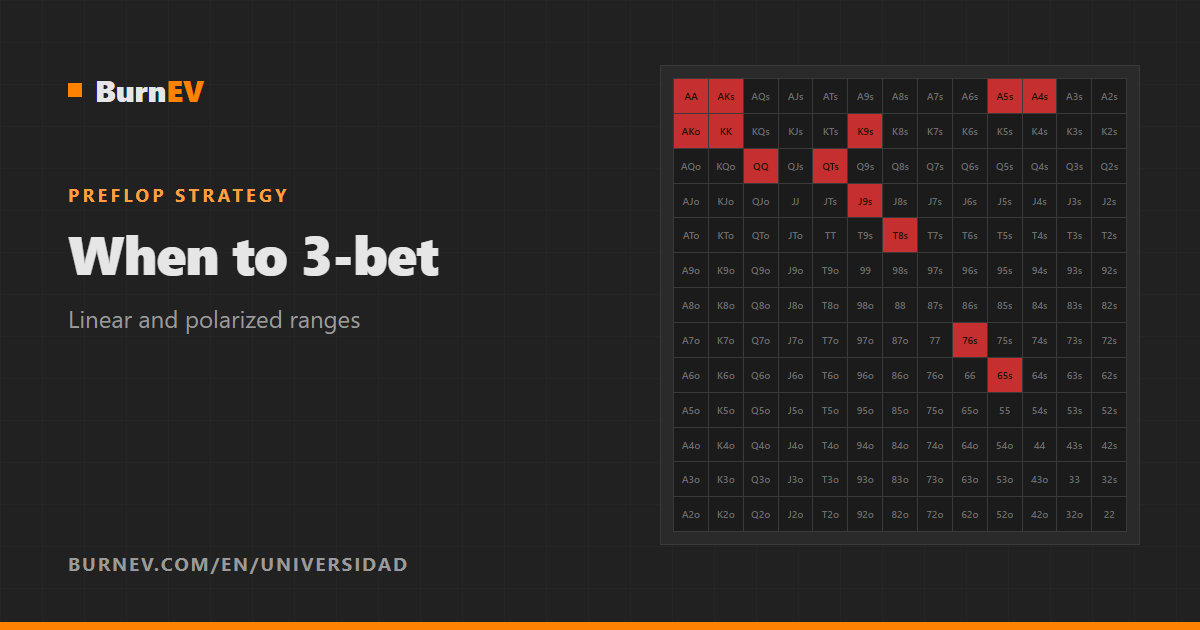
A polarized range combines two extremes: very strong hands (value) and hands that don’t want to call but have good bluffing properties. The middling hands, which play well as calls, are called.
Sample range · polarized 3-bet · 5.0%
Value 3-bets: QQ+, AK. Bluff 3-bets: A5s-A4s, K9s, QTs, J9s, T8s, 76s, 65s.
It works when your opponent folds a lot to 3-bets or 4-bets often: your bluffs win the pot outright and your value hands are happy to play a huge pot. It’s the typical structure from the blinds, as in big blind defense.
Which one to use in each spot
| Situation | Usual structure | Why |
|---|---|---|
| In position (BTN vs CO) | More linear | You can call 4-bets and play medium hands well postflop |
| Out of position (blinds) | More polarized | Medium hands play poorly out of position and you’d rather call or fold them |
| Opponent who calls a lot | Linear, fewer bluffs | They pay you off with worse hands |
| Opponent who folds a lot | Polarized, more bluffs | Fold equity makes bluffs profitable |
Build your 3-bet charts with three actions (3-bet, call and fold) and drill them in Burn EV: practice mode accepts any action of a mixed hand.
How to choose your 3-bet bluffs
Not every weak hand is a good bluff. The best ones have some of these traits:
- Blockers: an ace (A5s, A4s) reduces your opponent’s AA and AK combos, the hands they’d continue with. To understand why, see poker combinatorics.
- Playability: if called, suited connectors can hit draws and win big pots.
- They don’t play well as calls: hands that would lose value as a call are better candidates than ones that are already a good call.
Common mistake
3-bet bluffing with hands like KJo or QTo. If called they’re dominated, and if 4-bet you have to fold them. They’re better as a call or a fold.
3-bet sizing
Sizing depends mainly on position:
| Situation | Usual size | Against a 2.5bb open |
|---|---|---|
| In position | ≈ 3× the open | 7.5–8bb |
| Out of position | ≈ 4× the open | 10–11bb |
| Tournament with 20–25bb | Small or just all-in | See 3-bet shove |
Out of position you raise bigger so your opponent can’t call cheaply and use their positional advantage. With short stacks in tournaments, shoving is often better than a standard 3-bet: we cover it in 3-bet shoving with 15–25 big blinds.
Frequently asked questions
What is a 3-bet in poker?
A preflop re-raise: someone opens and you raise again. It’s called that because the blinds count as the first bet and the open as the second.
What is the difference between a linear and a polarized 3-bet?
A linear range 3-bets the best hands from the top down. A polarized range combines very strong hands with bluffs and calls with the middling hands.
Which hands should you 3-bet bluff with?
Hands that block your opponent’s strong hands (like A5s or A4s) or that play well when called (suited connectors). Avoid dominated offsuit hands.
How big should a 3-bet be?
Around 3 times the open in position and about 4 times out of position.
Read next: 3-bet shoving in tournaments.