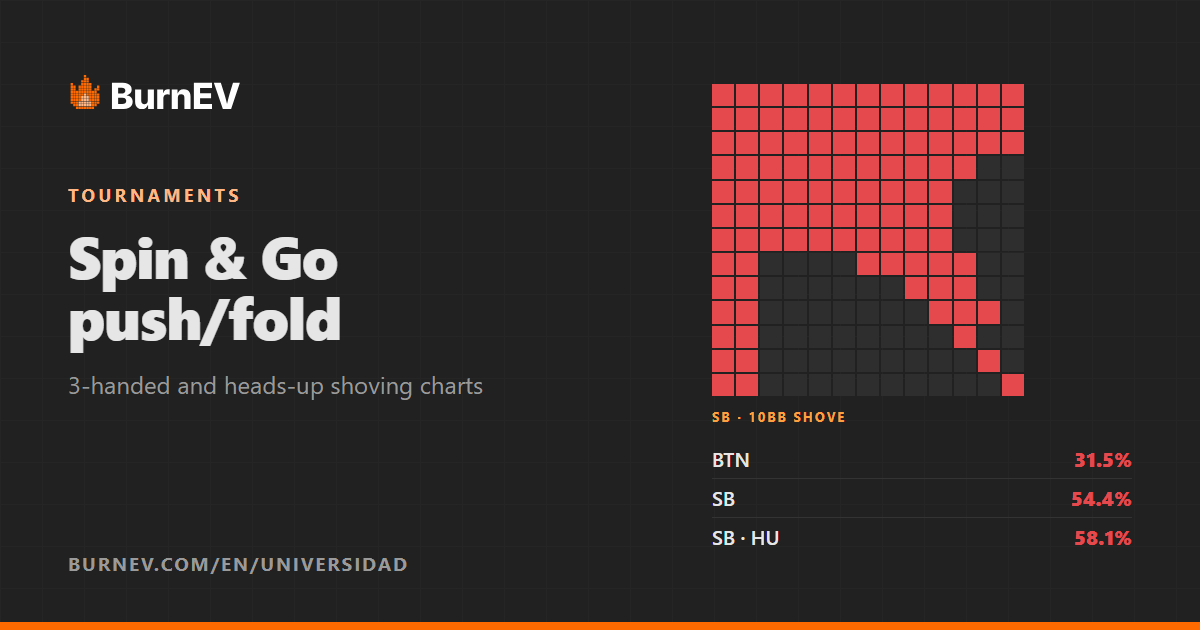
A Spin & Go starts with around 25 big blinds and the blinds go up every few minutes, so a big part of the game is played with 10 big blinds or less. Every decision there is all-in or fold. This guide gives you Spin & Go push/fold charts for 3-handed and heads-up play, calculated with a solver, and how they change with each stack depth.
Why push/fold rules Spin & Go
A Spin & Go is a fast three-player tournament. Stacks are short from the start and the structure is very fast, so getting down to 10 big blinds takes just a few hands. With so few chips, opening and folding to a re-raise leaves you crippled, and opening and calling commits you anyway. The most profitable play is to shove or fold.
The good news is that push/fold can be studied almost completely: there are few spots (who shoves and who calls) and each one needs just one chart. If you know them, you play the decisive phase of the game almost perfectly.
When to switch to push/fold
It all depends on the effective stack: the smaller of yours and the stack of the opponent who can call you, in big blinds. As a reference:
| Effective stack | Usual strategy |
|---|---|
| 25–15bb | Limps, small raises and shoves depending on hand and position. |
| 15–10bb | More and more shoves; small raises with only a few hands. |
| Under 10bb | Almost pure push/fold: all-in or fold. |
If your opponent has fewer chips than you, you play with their stack: with 20 big blinds against someone with 8, you shove as if you had 8.
How these charts were calculated
The ranges come from the Burn EV preflop solver: we found the equilibrium between the three players (or two, heads-up) when the only options are all-in or fold, with real cards in every hand and no antes, as in Spin & Go. They are in chips (no ICM) and without mixed strategies: each hand has a single action, so they are easy to study. Heads-up at 10bb the solver gives 58.1% shoves and 37.3% calls, matching the reference Nash charts.
The positions are those of a three-handed table: BTN (the button, first to act preflop), SB (small blind) and BB (big blind). If you need a refresher, read poker table positions explained.
3-handed push/fold at 10bb
BTN: shove 31.5%
With two players behind, the button needs a bit more: every pair, any ace, suited kings down to K5s, the broadways and some suited connectors.
Spin & Go · 10bb · BTN shove · 31.5%
All-in: 22+, A2s+, K5s+, Q8s+, J8s+, T8s+, 98s, 87s, A2o+, KTo+, QTo+, JTo.
SB when the BTN folds: shove 54.4%
Only the big blind is left and you already have half a blind in: more than half of all hands are a shove. Any ace, any king, almost every suited queen and lots of connected hands.
Spin & Go · 10bb · SB shove (BTN fold) · 54.4%
All-in: 22+, A2s+, K2s+, Q2s+, J4s+, T5s+, 95s+, 85s+, 74s+, 64s+, 53s+, A2o+, K2o+, Q8o+, J8o+, T8o+, 98o, 87o.
BB vs the SB shove: call 37.3%
The big blind already has a full blind in and the SB range is very wide, so it calls a lot: pairs, aces, almost every king and the best queens.
Spin & Go · 10bb · BB call vs SB · 37.3%
Call: 22+, A2s+, K2s+, Q7s+, J8s+, T9s, A2o+, K5o+, Q9o+, JTo.
Against the BTN shove
The button shoves a stronger range, so the blinds call much less. The SB calls 18.7%; if the SB folds, the BB calls 25.5%, and if the SB has already called, the BB only continues with 12.8% (44+, A9s+, KTs+, QTs+, JTs, ATo+, KQo), because it now faces two ranges instead of one.
Spin & Go · 10bb · SB call vs BTN · 18.7%
Call: 33+, A2s+, KTs+, QTs+, A7o+, KJo+.
Spin & Go · 10bb · BB call vs BTN (SB fold) · 25.5%
Call: 22+, A2s+, K8s+, QTs+, JTs, A3o+, KTo+, QJo.
The key idea
You shove much wider than you call. When you shove you also win whenever everyone folds (fold equity); when you call, you only win if your hand is best at showdown.
How ranges change with stack depth
The shorter you are, the wider you shove and the wider you call. This is the percentage of hands in each spot, from 15 to 6 big blinds:
| Stack | BTN shove | SB shove | BB call vs SB | SB call vs BTN | BB call vs BTN |
|---|---|---|---|---|---|
| 15 bb | 24.6% | 42.1% | 28.8% | 13.4% | 16.9% |
| 12 bb | 30.6% | 50.2% | 33.0% | 16.9% | 22.2% |
| 10 bb | 31.5% | 54.4% | 37.3% | 18.7% | 25.5% |
| 8 bb | 32.7% | 60.8% | 44.5% | 23.7% | 30.0% |
| 6 bb | 37.6% | 67.7% | 53.5% | 29.7% | 37.6% |
At 15 and 12 big blinds these numbers are for a pure all-in-or-fold tree: in practice, at that depth you also open small with many hands. For those stacks, also read 3-bet shoving in tournaments.
Load these charts into Burn EV and drill them with the quiz by stack and position: every chart in the University has a button to practise it. Try it free for 14 days.
Heads-up push/fold at 10bb
Once the first player busts, the Spin & Go is decided heads-up, often with few big blinds. Here the SB is also the button and shoves a huge range:
Heads-up · 10bb · SB shove · 58.1%
All-in: 22+, A2s+, K2s+, Q2s+, J2s+, T4s+, 94s+, 84s+, 74s+, 64s+, 53s+, 43s, A2o+, K2o+, Q7o+, J8o+, T8o+, 97o+, 87o.
Heads-up · 10bb · BB call · 37.3%
Call: 22+, A2s+, K2s+, Q7s+, J8s+, T9s, A2o+, K5o+, Q9o+, JTo.
| Stack | SB shove | BB call |
|---|---|---|
| 15 bb | 45.7% | 28.5% |
| 12 bb | 53.2% | 33.0% |
| 10 bb | 58.1% | 37.3% |
| 8 bb | 61.4% | 45.4% |
| 6 bb | 68.6% | 54.4% |
Adjustments in practice
- Uneven stacks: always play the effective stack. If the BB has 4 big blinds, the SB shoves even wider against them.
- Opponents who call too much: remove the hands that rely on fold equity (connectors, weak offsuit hands) from your shoving range and keep the value hands.
- Opponents who call too little: shove wider than the chart.
- Several payouts: in Spin & Go games that pay second place, busting costs more than the chips you win. Call a bit tighter and shove a little less. More in what ICM is in poker.
Common mistakes
Common mistake
Waiting for “a good hand” with 7 big blinds. Blinds go up very fast in a Spin & Go: every orbit you wait costs you fold equity and you end up shoving 3 big blinds with a hand nobody will fold to.
- Calling with the same range you would shove: your calling range is always tighter.
- Limping or min-raising and folding with 6–8 big blinds: you give away chips you can’t afford to lose.
- Forgetting who is left to act: against the BTN shove, the SB has to remember that the BB can still wake up with a hand.
- Studying them once and never again: these charts are short and easy to forget. Review them with the method in how to memorize poker ranges.
Frequently asked questions
How many big blinds do you play push/fold in a Spin & Go?
Below about 10–12 effective big blinds, almost everything is all-in or fold. Between 12 and 20 you mix shoves with limps and small raises.
Why does the small blind shove so many hands?
Because only one opponent is left to act and you already have half a blind in the pot: you often win the blinds uncalled, and when you get called you still have enough equity.
Do Nash charts work in Spin & Go?
Yes, especially in winner-take-all games: every chip counts there and the chip equilibrium is the best reference. With several payouts you should call a bit tighter because of ICM.
Which stack counts, mine or my opponent’s?
The effective stack: the smaller of your stack and the stack of the opponent who can call you, measured in big blinds.
Playing regular tournaments? The general guide is push/fold strategy: how to play a short stack in tournaments.