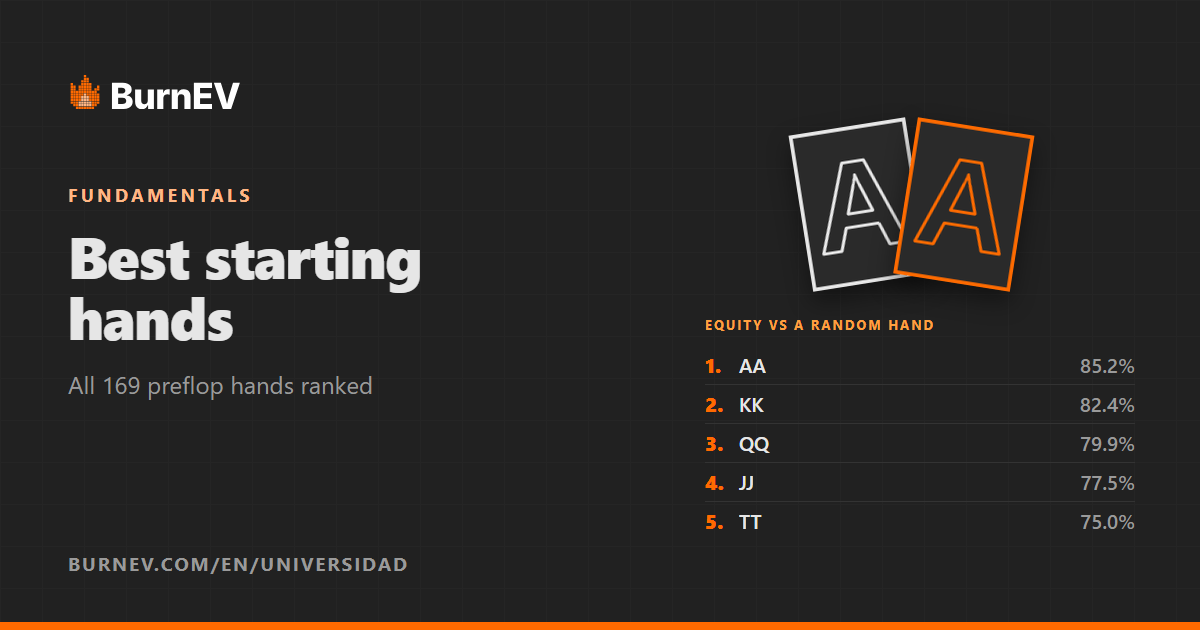
There are 169 different starting hands in Texas Hold’em. Everyone knows AA is the best, but what comes next? Is AKs worth more than a pair of sevens? Is 72o really the worst? This guide gives you the poker starting hand rankings, ordered by equity, and, most importantly, how to use them without mistaking them for an opening range.
The 10 best starting hands in poker
These are the ten hands with the most equity before the flop. The right-hand column is how often they win when the hand is played to the river against any random hand:
| # | Hand | Example | Equity vs a random hand |
|---|---|---|---|
| 1 | AA | A♠ A♥ | 85.2% |
| 2 | KK | K♠ K♥ | 82.4% |
| 3 | Q♠ Q♥ | 79.9% | |
| 4 | JJ | J♠ J♥ | 77.5% |
| 5 | TT | 10♠ 10♥ | 75.0% |
| 6 | 99 | 9♠ 9♥ | 72.0% |
| 7 | 88 | 8♠ 8♥ | 69.2% |
| 8 | AKs | A♠ K♠ | 67.0% |
| 9 | 77 | 7♠ 7♥ | 66.2% |
| 10 | AQs | A♠ Q♠ | 66.2% |
Seven of the ten are pocket pairs. Against a single random hand, a pair is already ahead most of the time, and that weighs heavily on equity. That is why AKs is 8th (67.0%) and AKo is 12th, behind 88 and 77.
In practice, AK plays like one of the top four or five hands: it makes the best pairs and straights, is rarely dominated and blocks AA and KK. As we will see below, equity and playability are not the same thing.
Don’t mix them up
This ranking orders starting hands (your two hole cards). If you are looking for the order of five-card hands (royal flush, four of a kind, full house…), see poker hand rankings.
How this ranking was made
There are many ways to rank starting hands. We use the most objective one: all-in equity against a random hand. For each of the 169 hands we simulated one hundred thousand deals against every possible hand, with five random community cards, and counted how often it wins (ties count as half). Each opposing hand is weighted by its combos: a pair has 6, a suited hand 4 and an offsuit hand 12.
The numbers were calculated with the Burn EV calculator and match the usual reference tables: AA wins 85.2% of the time and 72o, 34.6%. For a refresher on equity and why it matters, read what is EV in poker.
Starting hands by group
Rather than memorising 169 positions, it is more useful to see the shape of the ranking on the grid. Here are the hands in the top 10% of combos (20 hands), 10–25% (27 hands) and 25–50% (43 hands):
Best starting hands by equity · groups by % of combos
Groups by equity against a random hand, adding up combos. Top 10%: AA, KK, QQ, JJ, TT, 99, 88, AKs, 77, AQs, AJs, AKo, ATs, AQo, AJo, KQs, 66, A9s, ATo, KJs. 10–25%: A8s, KTs, KQo, A7s, A9o, KJo, 55, QJs, K9s, A5s, A6s, A8o, KTo, QTs, A4s, A7o, K8s, A3s, QJo, K9o, A6o, A5o, Q9s, JTs, K7s, A2s, QTo. 25–50%: 44, A4o, K6s, Q8s, K8o, A3o, K5s, J9s, Q9o, JTo, K7o, A2o, K4s, Q7s, K6o, K3s, J8s, T9s, 33, Q6s, Q8o, K5o, J9o, K2s, Q5s, T8s, K4o, J7s, Q4s, Q7o, T9o, J8o, K3o, Q3s, Q6o, 98s, T7s, J6s, K2o, 22, Q2s, Q5o, J5s.
Three things stand out: every pocket pair is inside the top 50%, aces (suited and offsuit) rank very high even with a weak kicker, and two high cards beat low connected cards. Note that the percentage counts combos, not grid squares: offsuit hands have three times as many combos as suited ones.
In Burn EV you see any range on the grid with its combo percentage, compare it in the calculator and drill it until you know it by heart. Try it free for 14 days.
Suited vs offsuit: what the suit is worth
Being suited adds between 1.7 and 3.7 points of equity (2.75 on average across the 78 suited/offsuit pairs). For example, AKs wins 67.0% and AKo 65.3%. It looks small, but a flush draw also wins big pots, which is why suited hands show up in far more ranges than their offsuit versions.
The worst starting hands
72o has the reputation, but against a random hand the worst starting hand is 32o (32.3%). 72o is ranked 165th (34.6%): its 7 beats more high cards than a 3, even though it cannot make a straight with the 2. The bottom eight are:
- 63o: 36.1% (#162)
- 32s: 36.0% (#163)
- 43o: 35.1% (#164)
- 72o: 34.6% (#165)
- 52o: 34.3% (#166)
- 62o: 34.1% (#167)
- 42o: 33.2% (#168)
- 32o: 32.3% (#169)
They are all low-card hands with no high card to save them when nobody connects. The only suited one is 32s: the flush adds some equity, but not enough to climb off the bottom.
Why this ranking is not your opening range
It is the most common mistake with a list like this: opening the “best” hands from the top down to a percentage. It does not work, for four reasons:
- Nobody plays against a random hand: whoever raises or calls already has a stronger range, and against it dominated hands (A3o, K9o) lose a lot of value.
- Playability matters: K2o is ranked 86 and 76s 115, yet 76s is opened in many more spots because it makes straights and flushes and rarely wins a small pot only to lose a big one.
- Position changes everything: in 6-max you open around 17–18% of hands from UTG and 42–48% from the button. See preflop opening ranges by position.
- So does your stack: with few big blinds (push or fold) raw equity matters more and the ranking gets much closer to the right strategy. We explain it in push or fold strategy.
Common mistake
Opening “the top 20%” of this ranking from every position. Use the ranking to understand which hands are strong and why, but play with preflop charts built for each spot.
All 169 starting hands ranked
Here are all 169 hands from best to worst, with their equity against a random hand:
| # | Hand | Equity |
|---|---|---|
| 1 | AA | 85.2% |
| 2 | KK | 82.4% |
| 3 | 79.9% | |
| 4 | JJ | 77.5% |
| 5 | TT | 75.0% |
| 6 | 99 | 72.0% |
| 7 | 88 | 69.2% |
| 8 | AKs | 67.0% |
| 9 | 77 | 66.2% |
| 10 | AQs | 66.2% |
| 11 | AJs | 65.4% |
| 12 | AKo | 65.3% |
| 13 | ATs | 64.6% |
| 14 | AQo | 64.4% |
| 15 | AJo | 63.6% |
| 16 | KQs | 63.4% |
| 17 | 66 | 63.3% |
| 18 | A9s | 62.8% |
| 19 | ATo | 62.7% |
| 20 | KJs | 62.6% |
| 21 | A8s | 61.9% |
| 22 | KTs | 61.8% |
| 23 | KQo | 61.5% |
| 24 | A7s | 61.0% |
| 25 | A9o | 60.8% |
| 26 | KJo | 60.6% |
| 27 | 55 | 60.3% |
| 28 | QJs | 60.3% |
| 29 | K9s | 60.0% |
| 30 | A5s | 59.9% |
| 31 | A6s | 59.9% |
| 32 | A8o | 59.8% |
| 33 | KTo | 59.7% |
| 34 | QTs | 59.5% |
| 35 | A4s | 59.1% |
| 36 | A7o | 58.8% |
| 37 | K8s | 58.3% |
| 38 | A3s | 58.2% |
| 39 | QJo | 58.1% |
| 40 | K9o | 57.8% |
| 41 | A6o | 57.7% |
| 42 | A5o | 57.7% |
| 43 | Q9s | 57.6% |
| 44 | JTs | 57.5% |
| 45 | K7s | 57.5% |
| 46 | A2s | 57.4% |
| 47 | QTo | 57.3% |
| 48 | 44 | 57.0% |
| 49 | A4o | 56.7% |
| 50 | K6s | 56.6% |
| 51 | Q8s | 56.0% |
| 52 | K8o | 56.0% |
| 53 | A3o | 55.8% |
| 54 | K5s | 55.8% |
| 55 | J9s | 55.7% |
| 56 | Q9o | 55.4% |
| 57 | JTo | 55.3% |
| 58 | K7o | 55.2% |
| 59 | A2o | 54.9% |
| 60 | K4s | 54.9% |
| 61 | Q7s | 54.3% |
| 62 | K6o | 54.2% |
| 63 | K3s | 54.1% |
| 64 | J8s | 54.0% |
| 65 | T9s | 54.0% |
| 66 | 33 | 53.7% |
| 67 | Q6s | 53.6% |
| 68 | Q8o | 53.6% |
| 69 | K5o | 53.3% |
| 70 | J9o | 53.2% |
| 71 | K2s | 53.2% |
| 72 | Q5s | 52.8% |
| 73 | T8s | 52.3% |
| 74 | K4o | 52.3% |
| 75 | J7s | 52.3% |
| 76 | Q4s | 51.8% |
| 77 | Q7o | 51.8% |
| 78 | T9o | 51.5% |
| 79 | J8o | 51.5% |
| 80 | K3o | 51.4% |
| 81 | Q3s | 51.0% |
| 82 | Q6o | 51.0% |
| 83 | 98s | 50.8% |
| 84 | T7s | 50.6% |
| 85 | J6s | 50.6% |
| 86 | K2o | 50.5% |
| 87 | 22 | 50.3% |
| 88 | Q2s | 50.2% |
| 89 | Q5o | 50.1% |
| 90 | J5s | 50.0% |
| 91 | T8o | 49.7% |
| 92 | J7o | 49.7% |
| 93 | Q4o | 49.1% |
| 94 | 97s | 49.1% |
| 95 | J4s | 49.1% |
| 96 | T6s | 48.9% |
| 97 | J3s | 48.2% |
| 98 | Q3o | 48.2% |
| 99 | 98o | 48.1% |
| 100 | 87s | 47.9% |
| 101 | T7o | 47.9% |
| 102 | J6o | 47.8% |
| 103 | 96s | 47.4% |
| 104 | J2s | 47.4% |
| 105 | Q2o | 47.3% |
| 106 | T5s | 47.2% |
| 107 | J5o | 47.2% |
| 108 | T4s | 46.5% |
| 109 | 97o | 46.3% |
| 110 | 86s | 46.2% |
| 111 | J4o | 46.2% |
| 112 | T6o | 46.1% |
| 113 | 95s | 45.7% |
| 114 | T3s | 45.7% |
| 115 | 76s | 45.4% |
| 116 | J3o | 45.3% |
| 117 | 87o | 45.0% |
| 118 | T2s | 44.8% |
| 119 | 85s | 44.6% |
| 120 | 96o | 44.5% |
| 121 | J2o | 44.4% |
| 122 | T5o | 44.3% |
| 123 | 94s | 43.8% |
| 124 | 75s | 43.7% |
| 125 | T4o | 43.5% |
| 126 | 93s | 43.3% |
| 127 | 86o | 43.2% |
| 128 | 65s | 43.1% |
| 129 | 84s | 42.7% |
| 130 | 95o | 42.7% |
| 131 | T3o | 42.6% |
| 132 | 92s | 42.4% |
| 133 | 76o | 42.3% |
| 134 | 74s | 41.8% |
| 135 | T2o | 41.7% |
| 136 | 54s | 41.4% |
| 137 | 85o | 41.4% |
| 138 | 64s | 41.3% |
| 139 | 83s | 40.9% |
| 140 | 94o | 40.7% |
| 141 | 75o | 40.5% |
| 142 | 82s | 40.3% |
| 143 | 73s | 40.0% |
| 144 | 93o | 40.0% |
| 145 | 65o | 39.9% |
| 146 | 53s | 39.7% |
| 147 | 63s | 39.6% |
| 148 | 84o | 39.5% |
| 149 | 92o | 39.1% |
| 150 | 43s | 38.6% |
| 151 | 74o | 38.6% |
| 152 | 54o | 38.2% |
| 153 | 72s | 38.2% |
| 154 | 64o | 38.0% |
| 155 | 52s | 37.8% |
| 156 | 62s | 37.7% |
| 157 | 83o | 37.5% |
| 158 | 82o | 36.8% |
| 159 | 42s | 36.8% |
| 160 | 73o | 36.6% |
| 161 | 53o | 36.3% |
| 162 | 63o | 36.1% |
| 163 | 32s | 36.0% |
| 164 | 43o | 35.1% |
| 165 | 72o | 34.6% |
| 166 | 52o | 34.3% |
| 167 | 62o | 34.1% |
| 168 | 42o | 33.2% |
| 169 | 32o | 32.3% |
How to get the most out of it
- Learn the shape, not the positions: pairs, aces, broadways and suited connectors form blocks you will see in every range.
- Use it for borderline hands: when you hesitate between two similar hands (A9o or KTo), the ranking gives a hint, but the chart for your spot has the final say.
- Actually drill your ranges: knowing a list does not help at the table; answering quickly hand by hand does. Here is how in how to memorize poker ranges.
Build your preflop charts in Burn EV, compare them with the calculator and drill them with hand-by-hand quizzes and hidden mode.
Frequently asked questions
What is the best starting hand in poker?
AA (pocket aces). It wins about 85% of the time against a random hand when played to the river, and it is the favourite against every other starting hand.
What is the worst starting hand in poker?
Against a random hand, 32o (three-deuce offsuit), with 32% equity. The famous 72o is the fifth worst, at 34.6%.
Is AK better than a pocket pair?
By equity against a random hand, AKs ranks 8th, behind the pairs from AA to 88. Against a specific pair lower than an ace, AK is a coin flip or a slight underdog (43% to 50%, depending on the pair and whether it is suited), but in practice AK plays as one of the best hands because it is rarely dominated.
How many starting hands are there in Texas Hold’em?
169 different hands: 13 pairs, 78 suited and 78 offsuit. Counting suits, there are 1,326 two-card combinations.
Should I open hands according to this ranking?
Not directly. The ranking measures equity against a random hand; your opening ranges depend on position, stack depth, opponents and how playable each hand is. Use it to understand hand strength and play with preflop charts built for each situation.
Next read: poker hand rankings.