The big blind is the position where almost every player loses the most money, winners included. That’s normal: you post a forced blind and play out of position. But there’s a big difference between losing a little and losing a lot, and that difference comes down to knowing how to defend the BB: when to call, when to 3-bet and when to fold.
Why the big blind defends so many hands
When someone opens and the action reaches you in the big blind, you already have 1bb in the pot. That changes everything:
- You pay less: you only make up the difference to the raise.
- The pot is bigger: it includes your blind, the SB’s and the open.
- You close the action: nobody can raise after you, so you’re guaranteed to see the flop.
As a result, you need very little equity for a call to be profitable, and lots of hands you’d never open become correct defends. The BB loses money on average, but folding too much loses even more: every hand you fold gives away your whole blind.
The price of defending by open-raise size
Say the button opens, the small blind folds and you’re in the BB:
| Open size | You call | Final pot | Minimum equity |
|---|---|---|---|
| 2bb | 1bb | 4.5bb | 22% |
| 2.5bb | 1.5bb | 5.5bb | 27% |
| 3bb | 2bb | 6.5bb | 31% |
The smaller the open, the more hands you can defend. Against a min-raise you defend a huge range; against 3bb, quite a bit less. (If you need to review the math, see what EV and pot odds are.)
Important nuance
Minimum equity is a reference, not a rule. Out of position you don’t realize all your equity: weak, unconnected hands win less than their equity suggests. That’s why you don’t defend everything that clears the threshold.
How much to defend depending on who opens
The opener’s range decides how much you can defend. Against strong ranges your medium hands are dominated; against wide ranges they have plenty of equity.
| Opens from | Their approx. range | Your approx. defense (6-max, 2.5bb) |
|---|---|---|
| UTG | ≈ 17% | ≈ 25–30% |
| CO | ≈ 29% | ≈ 35–40% |
| BTN | ≈ 42% | ≈ 45–50% |
| SB | ≈ 40–50% | ≈ 55–65% |
These are approximate figures for 6-max cash at 100bb: every solver and format gives slightly different numbers, but the progression is always the same. You can see the opening ranges in preflop opening ranges by position.
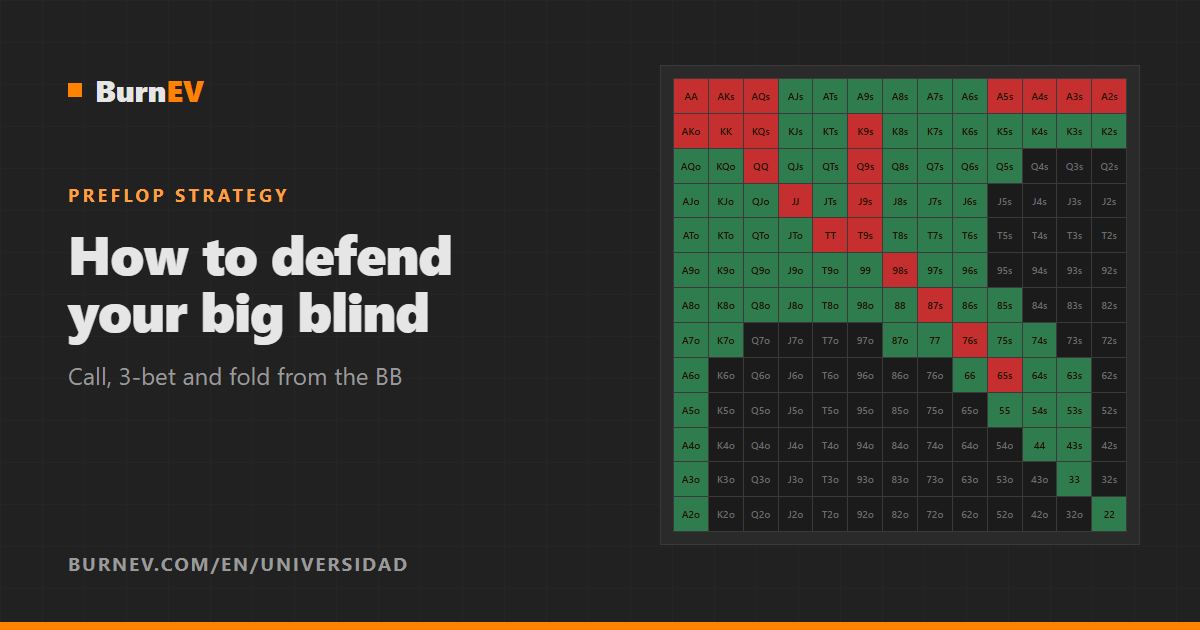
BB defense chart vs the button
A sample BB defense against a 2.5bb button open, with a polarized 3-bet and a wide calling range:
Sample range · BB vs BTN 2.5bb · 6-max 100bb · 48.4%
3-bet (7.7%): TT+, AQs+, AKo, A5s-A2s, KQs, K9s, Q9s, J9s, T9s, 98s, 87s, 76s, 65s. Call (40.7%): 99-22, AJs-A6s, KJs-KTs, K8s-K2s, QJs, QTs, Q8s-Q5s, JTs, J8s-J6s, T8s-T6s, 97s-96s, 86s-85s, 75s-74s, 64s-63s, 54s, 53s, 43s, AQo-A2o, K7o+, Q8o+, J8o+, T8o+, 98o, 87o.
Look at the shape: almost every suited hand, every pair and every ace is defended, and offsuit hands down to a fairly low edge. What gets folded is mostly weak, unconnected offsuit hands (K6o, Q7o, 95o…).
Paint your BB defenses against each position and drill them with the quiz. They’re the charts that save you the most money.
Call or 3-bet
Most of your defense is calling, but a good BB range includes a share of 3-bets:
- Value 3-bets: hands that want to play a big pot (TT+, AQs+, AK).
- Bluff 3-bets: hands that play so-so as a call but have blockers or playability, like A5s-A2s or some suited connectors.
From the BB, 3-bets are usually bigger than in position (around 4 times the open, or 11–12bb against 2.5bb), because you’ll play the rest of the hand out of position. You’ll find the full explanation in when to 3-bet.
Which hands to defend (and which not to)
The hands that defend best are the ones that realize their equity well out of position:
- Suited hands: they can hit flushes and draws, which is why almost all of them are defended against late-position opens.
- Connected hands: easier straights and two pairs.
- Pairs: they can flop a set and win big pots.
Common mistake
Defending offsuit hands “because they have a high card” against early-position opens: KTo or QJo against UTG are very often dominated by KQ, AK, AQ or AJ and lose big pots.
Big blind defense in tournaments
In tournaments with a big blind ante the pot is even bigger when it’s your turn, so the price improves and you defend even more. On the other hand, with short stacks another option appears: the 3-bet shove, going all-in over the open. With 15–25bb it usually replaces much of the standard 3-bet; we explain it in 3-bet shoving in tournaments.
Frequently asked questions
How many hands should you defend from the big blind?
It depends on who opens and the size. Against a 2.5bb button open in 6-max cash, around 45–50%; against UTG, quite a bit less, around 25–30%.
Why do you defend so many hands from the BB?
Because you already have a blind in the pot, you pay little to see the flop and you close the action. Folding too much gives away your blind far too often.
Is it better to call or 3-bet from the big blind?
Most hands are defended by calling. 3-bets are reserved for the strongest hands and some bluffs with blockers, like A5s.
Which hands should I not defend in the BB?
Mainly weak, unconnected offsuit hands, which play poorly out of position, and dominated offsuit hands against early-position opens.
Read next: when to 3-bet: linear vs polarized ranges.