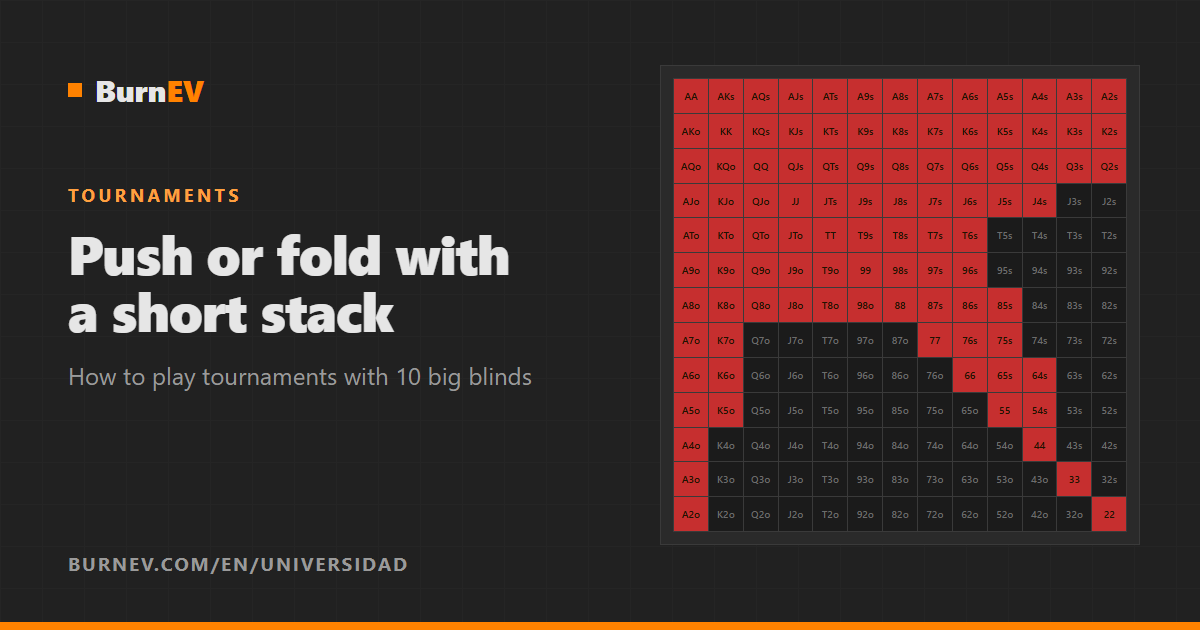
In poker tournaments you spend a big chunk of time with a short stack. With 10 or 12 big blinds there’s no room left to open, see a flop and play: every preflop decision is all-in or fold. This phase, known as push/fold, is one of the easiest to study and one where the most money is lost by not studying it. Here’s when it starts, how it works and which ranges to use.
What is push/fold in poker?
It’s a preflop strategy where you only have two options when the action folds to you: go all-in (push or shove) or fold. No standard raises, no limps. You use it when your stack is so short that opening and folding to a re-raise would leave you crippled, and opening and calling commits you anyway.
The interesting part is that with very short stacks this simplified strategy is very close to optimal. That’s why there are push/fold charts calculated from Nash equilibrium that you can study and apply almost as they are.
When to switch to push/fold
It all depends on the effective stack: the smaller of your stack and the stack of the opponent who can call you, measured in big blinds. If you have 30bb but the only player who can call has 8bb, you play as if you had 8bb.
| Effective stack | Usual preflop strategy |
|---|---|
| Over 25bb | Standard open-raise, defense and 3-bets as with a medium stack. |
| 15–25bb | Small open-raises, raise-fold, and 3-bet shoves against opens come into play. |
| 10–15bb | A mix of open-shoves and small raises depending on position and hand. |
| Under 10bb | Almost pure push/fold. |
These thresholds are approximate. In tournaments with antes the starting pot is bigger and push/fold starts a little earlier; without antes, a little later.
Why it works: fold equity
When you go all-in you win in two ways: when everyone folds (you pick up the blinds and antes without a showdown) and when you get called and win the hand. The first part is called fold equity, and it’s the reason you can shove hands you’d never call with.
That’s why there’s a golden rule: your shoving range is much wider than your calling range. When you shove, your opponent needs a hand to call; when you call, you have to win at showdown with no fold equity at all.
The key idea
The fewer players left to act, the more often everyone folds and the wider you can shove. That’s why the small blind, with just one opponent behind, shoves a huge number of hands.
10bb push/fold ranges
These examples are approximate, for 10bb effective at a full-ring table without ICM. They show the progression: the later the position, the wider the range.
Early position (≈ 16%)
With many players behind, someone will have a hand to call. The range is limited to pairs, suited aces, suited broadways and big offsuit aces.
Sample range · 10bb shove · early position · 16.1%
All-in: 22+, A2s+, K9s+, QTs+, JTs, ATo+, KQo.
Cutoff (≈ 25%)
With three players behind you add more suited kings and queens, high connectors and medium offsuit aces.
Sample range · 10bb shove · CO · 24.9%
All-in: 22+, A2s+, K5s+, Q8s+, J8s+, T8s+, 98s, A7o+, KTo+, QJo.
Small blind vs big blind (≈ 50% or more)
Only one opponent is left and you already have half a blind in the pot. The range is huge: any ace, almost any king and lots of suited hands. Depending on the model and the antes, it can go from 50% to 60%.
Sample range · 10bb shove · SB vs BB · 49.6%
All-in: 22+, A2s+, K2s+, Q2s+, J4s+, T6s+, 96s+, 85s+, 75s+, 64s+, 54s, A2o+, K5o+, Q8o+, J8o+, T8o+, 98o.
Build one chart per stack depth (5, 8, 10, 12, 15bb…) and drill them with the quiz: practice asks you every hand at its effective stack.
How to call an all-in
Calling is a different story: there’s no fold equity, all that matters is whether your hand wins often enough against your opponent’s range for the call to be profitable. Three factors decide it:
- The shover’s range: calling a UTG shove is not the same as calling a small blind shove.
- Pot odds: from the big blind you already have money in, so you need less equity.
- What’s at stake: in a tournament, losing your whole stack costs more than the chips you win (ICM).
As a reference, a range to call a cutoff’s 10bb shove might be around 20–25%: pairs, aces and the best broadways. Notice it’s similar in size to the cutoff’s own shoving range, but with different hands at the edges: for calling, high cards (A7o) are worth more than suited connectors (98s).
Sample range · Call vs CO shove · 10bb · 22.8%
Call: 22+, A2s+, K7s+, Q9s+, J9s+, A7o+, KTo+, QJo.
Adjustments: antes, ICM and opponents
- With antes: the starting pot grows and shoving is more profitable. Widen your ranges, especially from late position.
- ICM: near the bubble or at the final table, busting is expensive. Shove a bit less and, above all, call a lot less.
- Opponents who call too much: remove the hands that rely on fold equity (connectors, weak offsuit hands) from your shoving range and keep the value hands.
- Opponents who call too little: shove wider.
Most common short-stack mistakes
Common mistake
Waiting for “a good hand” with 8bb. Every orbit costs you the blinds and antes, your fold equity shrinks and you end up shoving 4bb with a hand nobody will fold to.
- Limping or min-raising and folding with 6–8bb: you’re giving away chips you can’t afford to lose.
- Calling with the same range you’d shove: your calling range is always tighter.
- Ignoring the effective stack: if the player calling you has fewer chips than you, that’s the stack that counts.
- Studying it once and never reviewing it: push/fold charts are short and easy to forget. Review them with the method in how to memorize poker ranges.
Frequently asked questions
How many big blinds do you start playing push/fold?
As a rule of thumb, below about 10–12 effective big blinds. Between 12 and 20 you mix shoves with small opens and 3-bet shoves.
What is fold equity?
It’s the part of your profit that comes from your opponent folding. It’s what lets you go all-in with hands you wouldn’t call with.
Why is the calling range tighter than the shoving range?
Because when you call you have no fold equity: you only win if your hand is best at showdown. When you shove you also win whenever everyone folds.
Do push/fold charts work on the bubble?
They need ICM adjustments: near the money you should shove somewhat less and call considerably less than a chip-EV chart suggests.
Want to see how ranges change with deeper stacks? Check out the preflop opening ranges by position.