Never played before, or want a refresher before you sit down at a table? This is how to play Texas Hold’em No Limit poker, explained like the rulebook that comes with a board game: what you need, what the goal is, how the cards are dealt, what you can do on your turn, how much you can bet and who wins the pot. No strategy and no unnecessary jargon: just the rules.
What you need to play
- Players: 2 to 10 per table. The most common formats are 6 players (6-max) and 9.
- A standard 52-card deck, no jokers. Card values from highest to lowest: A (ace), K (king), Q (queen), J (jack), 10, 9, 8, 7, 6, 5, 4, 3 and 2. The ace can also be the lowest card in the straight 5-4-3-2-A. There are four suits (spades, hearts, diamonds and clubs) and no suit ranks above another.
- Chips: each player starts with a pile of chips (their stack). In cash games each chip is worth its face value; in a tournament, chips are only used to keep playing.
- A dealer button: a disc that shows who is the dealer for each hand, even if the same person (or a casino dealer) actually deals every time.
Object of the game
Win chips. In each hand, players bet into a shared pot, which goes to whoever has the best five-card hand at the end, or to the last player left when everyone else has folded. So there are two ways to win a pot: show down the best hand or make a bet nobody calls.
Each player gets two private cards face down, and up to five community cards are dealt face up in the middle of the table for everyone to use. Your hand is the best five cards out of those seven. To see which hand beats which, check the poker hand rankings; from highest to lowest: royal flush, straight flush, four of a kind, full house, flush, straight, three of a kind, two pair, one pair and high card.
Setup: the button and the blinds
Draw for the dealer button (for example, deal one card to each player: highest card gets it). After every hand, the button moves one seat to the left, always clockwise.
Before the cards are dealt, the two players to the left of the button post forced bets called the blinds:
- Small blind (SB): the first player to the left of the button. Usually half the big blind.
- Big blind (BB): the next player. It sets the minimum bet at the table. In a “1/2” game the small blind is 1 and the big blind is 2.
The blinds make sure there is always something to play for. In tournaments they go up at regular intervals, and an ante, a small extra forced bet, is often added. The name of each seat (UTG, CO, BTN…) is explained in poker table positions.
Two-player rule
With only two players (heads-up), the player on the button posts the small blind and the other posts the big blind. The button acts first before the flop and last on every later round.
How a hand is played, step by step
A hand has up to four betting rounds. Between rounds, the dealer discards (burns) the top card of the deck face down and then deals the next community cards.
- The deal: starting with the small blind, the dealer gives each player one card face down, then a second one. Everyone looks at their own cards without showing them.
- Preflop: first betting round. The player to the left of the big blind acts first, and the turn moves to the left. The blinds count as bets already made.
- Flop: the dealer burns a card and turns three community cards face up. Second betting round.
- Turn: burn another card and deal the fourth community card. Third round.
- River: burn another card and deal the fifth and final one. Fourth round.
- Showdown: if two or more players are still in after the river, they show their cards and the best hand wins the pot.
| Round | Cards on the board | Who acts first |
|---|---|---|
| Preflop | 0 | The player to the left of the big blind |
| Flop | 3 | The first player still in the hand to the left of the button |
| Turn | 4 | The first player still in the hand to the left of the button |
| River | 5 | The first player still in the hand to the left of the button |
If at any point everyone folds except one player, the hand ends right there: that player wins the pot without showing their cards, and no more community cards are dealt.
What you can do on your turn
When it’s your turn to act, you choose one of these actions. Which ones are available depends on whether someone has already bet in that round:
| Action | What it means | When you can do it |
|---|---|---|
| Check | You don’t bet and pass the turn without folding | Only if nobody has bet in the round |
| Bet | You put chips in the pot; the others must match it or fold | If nobody has bet in the round |
| Call | You put in enough chips to match the highest bet | If someone has bet |
| Raise | You match the bet and increase it | If someone has bet |
| Fold | You throw away your cards and give up the pot | Always |
| All-in | You bet all your chips | Any time it’s your turn |
A betting round ends when every player still in the hand has acted and everyone has put in the same amount (or is all-in). If nobody bets, everyone checks and the next card is dealt.
The big blind’s option
Before the flop, if nobody has raised, the big blind has already put in the amount that needs to be matched. So when it’s their turn they can check without adding chips, or raise. It’s the only time you can check preflop.
How much you can bet in No Limit
“No Limit” means there is no maximum bet: at any time you can bet every chip in front of you. There are minimums, though:
- Minimum bet: the size of the big blind. In a 1/2 game you can’t bet 1.
- Minimum raise: you have to raise by at least as much as the previous raise. If the blinds are 1/2 and someone raises to 6 (4 more than the big blind’s 2), the next raise must be to at least 10.
- Maximum: all your chips. Only the chips on the table at the start of the hand count: you can’t add more money in the middle of a hand.
If a player goes all-in for less than a minimum raise, the others can call it, but players who had already acted don’t get the right to raise again because of it.
Common mistake
Putting chips in with two motions: pushing out the call and then going back to your stack for more. At a live table that doesn’t count as a raise. To raise, say it out loud (“raise to 10”) or put all the chips in at once.
Showdown: who wins the pot
If two or more players are left after the last betting round, the cards are shown:
- The last player who bet or raised on the river shows first. If nobody bet, the first player to the left of the button starts.
- The best five-card hand wins, combining your two cards with the five on the board. You can use both, just one or neither (when the best hand is the five board cards, you are “playing the board”).
- A player who sees they are beaten can throw their cards away without showing them.
- If two players have exactly the same five-card hand, the pot is split. Suits never break ties. If the pot can’t be split evenly, the odd chip goes to the first player to the left of the button.
To break a tie between two hands of the same category (two pairs of aces, for example), see the section on ties and kickers in the poker hand rankings.
Once you know the rules, the next step is knowing which hands to play in each pot. In Burn EV you build your preflop charts and train them with quizzes until you know them by heart. Try it free for 14 days.
All-ins and side pots
You can never lose more chips than you have. If you go all-in and other players keep betting, a side pot is created:
- The main pot holds what the all-in player can win: their bet and the same amount from each opponent.
- Whatever the others bet beyond that goes into a separate pot that only they can win.
Example: Anna goes all-in for 20, and Ben and Carla, with 100 each, call and keep betting until they’ve each put in 100. The main pot is 60 (20 from each player) and all three play for it; the side pot is 160 (80 from Ben and 80 from Carla) and only Ben and Carla play for it. If Anna has the best hand, she wins the 60, and the side pot goes to the better hand between Ben and Carla.
A complete example hand
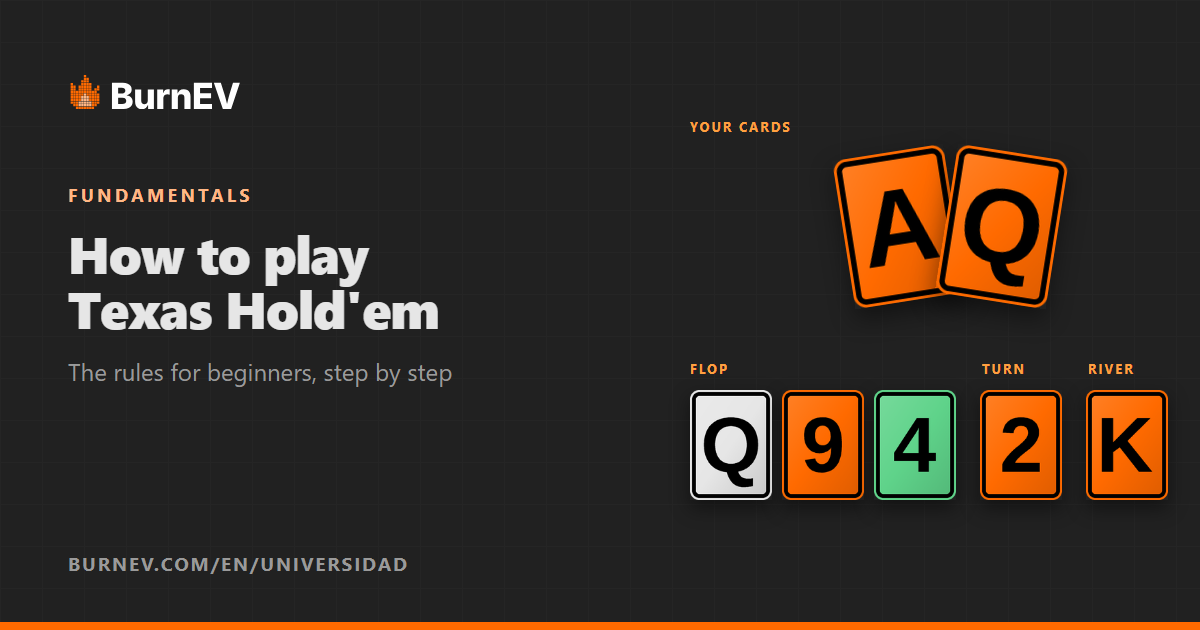
Four-handed table with 1/2 blinds. Dan has the button; Anna posts the small blind (1) and Ben the big blind (2). You are Carla and you’re dealt:
A♥ Q♥
- Preflop: you act first (you’re to the left of the big blind) and raise to 6. Dan folds, Anna folds and Ben calls by putting in 4 more. Pot: 1 + 6 + 6 = 13.
- Flop: Q♠ 9♥ 4♣. Ben acts first (he’s the first player still in the hand to the left of the button) and checks. You bet 8 with your pair of queens and Ben calls. Pot: 29.
- Turn: Q♠ 9♥ 4♣ 2♥. You both check.
- River: Q♠ 9♥ 4♣ 2♥ K♥. Ben bets 20 and you call.
- Showdown: Ben made the last bet, so he shows first: K♦ Q♦, two pair, kings and queens. You show A♥ Q♥: with three hearts on the board you have an ace-high flush (A♥ K♥ Q♥ 9♥ 2♥) and win the 69 pot.
A♥ Q♥ Q♠ 9♥ 4♣ 2♥ K♥
In the cards in this article, each suit has its own color, just like in the Burn EV apps: spades in white, hearts in orange, diamonds in blue and clubs in green. Dimmed cards are not part of your hand.
When the game ends
There are two ways to play Texas Hold’em, and each one ends differently:
- Cash game: chips are worth money, the blinds never change and you can join, top up your chips or leave whenever you like (between hands). There is no final winner: everyone leaves with the chips they have.
- Tournament: everyone pays the same buy-in and starts with the same chips. The blinds go up at set intervals and anyone who runs out of chips is eliminated. The tournament ends when one player has all the chips; prizes are paid according to finishing position.
Rules summary
The rules in 8 points
- Each player gets 2 private cards; up to 5 community cards are dealt on the board.
- Before the deal, the two seats to the left of the button post the blinds.
- There are 4 betting rounds: preflop, flop (3 cards), turn (1) and river (1).
- On your turn you can check, bet, call, raise, fold or go all-in.
- In No Limit you can bet all your chips; the minimum bet is the big blind.
- The pot goes to the last player left or to the best 5-card hand at showdown.
- Suits don’t break ties: identical hands split the pot.
- When the hand is over, the button moves to the player on the left.
Once the rules are clear, what decides whether you win or lose in the long run is which hands you choose to play and from which position. To start, look at the best starting hands in poker, then learn to read preflop charts, which sum up which cards to open, call or raise with in each spot.
Build your preflop charts in Burn EV and train them with hand quizzes, hidden mode and spaced repetition. Your first chart in five minutes.
Frequently asked questions
How many cards are dealt in Texas Hold’em?
Two private cards to each player, face down, and five community cards on the board: three on the flop, one on the turn and one on the river. Each player makes their hand with the best five of those seven.
What does No Limit mean?
There is no maximum bet: on your turn you can bet every chip you have on the table. The minimum bet is the big blind, and each raise must be at least as big as the previous one.
Who acts first in each betting round?
Before the flop, the player to the left of the big blind. On the flop, turn and river, the first player still in the hand to the left of the button.
Do you have to use both of your hole cards?
No. Your hand is the best five cards from your two and the five on the board: you can use both, one or neither.
How many players can play Texas Hold’em?
From 2 to 10 per table. The most common tables are 6 players (6-max) and 9.
Next read: poker hand rankings: from royal flush to high card.